Hyperliquid Tax Guide 2025: Everything you need to know
Trading on Hyperliquid can result in taxable events such as selling, staking, bridging, and providing liquidity. Here’s how to report it on your taxes.
 Summ
Summ Hyperliquid is an exciting new blockchain that is improving the scalability and usability of decentralized finance (DeFi). It launched in 2024, building on the success of its existing decentralised perpetuals exchange. However, many users are confused as to how to handle their potential Hyperliquid tax obligations.
Although local tax authorities like the Internal Revenue Service (IRS) do not provide guidance that is specific to Hyperliquid, there is plenty of information related to DeFi taxation that can be used to understand when transactions on Hyperliquid may be taxable.
This guide explains how to calculate taxes related to the DeFi services Hyperliquid provides. It is general in nature and does not provide guidance for any specific tax jurisdiction. Read our crypto tax guide for your region and consult a local tax professional for further guidance.
How is Hyperliquid taxed?
Since Hyperliquid is a DeFi platform with its own blockchain that provides a variety of different services, there are many potential areas of DeFi taxation to consider. The main Hyperliquid application is a decentralized exchange (DEX), but there are also additional features that may come with their own potential tax implications such as:
- Leverage trading
- Lending
- Bridging
- Airdrops
- Staking
In some cases, these DeFi activities may be taxed as income, while in other cases, capital gains taxes may apply.
Remember, the idea that crypto transactions are anonymous or untraceable is mostly a myth, as blockchain analytics can be used to trace user activity rather easily.
Interactions with any DeFi application can create multiple taxable events, and it’s critical to take a conservative approach with crypto taxes to avoid potential conflicts with the IRS. Something as innocuous and simple as bridging the same underlying crypto asset between two different blockchains can be considered a taxable event in DeFi.
Taxable events on Hyperliquid
How trading is taxed on Hyperliquid

In terms of trading activity on the Hyperliquid DEX, users will need to track any capital gains made on the platform. These gains are subject to capital gains taxes similar to activity on centralized crypto exchanges.
Whether trading between crypto-native assets and stablecoins or swapping between two different crypto assets, capital gains taxes will apply.
Even swaps made between two different forms of the same underlying crypto asset, such as bitcoin (BTC) and Wrapped Bitcoin (wBTC), are typically treated as taxable events.
How leverage trading is taxed on Hyperliquid

Taxes on crypto trading activity get a bit more complicated when leverage is involved.
Leverage trading involves the borrowing of cash to gain greater exposure to a particular asset that is being traded on a long or short basis. For example, someone trading with 10x leverage can effectively trade with the power of $1,000 while only putting down $100.
If you’re engaged in leverage trading on Hyperliquid, we recommend that you contact a tax professional in your local jurisdiction to make sure all your bases are covered.
The tax obligations involved may range from paying taxes on the gains made when trading on margin, to more complex things like how liquidation events are taxed. Additionally, these profits may count as income or capital gains depending on your legal structure.
If you are in the US, you can read our detailed guide on margin trading which includes guidance on how the IRS treats leverage trading, liquidation events, interest payments and more.
How staking is taxed on Hyperliquid

Since Hyperliquid operates as its own layer-one blockchain network, staking can be used to support the platform and earn rewards.
Validators on the network participate in the HyperBFT consensus process, and HYPE holders can delegate their stake to these validators to earn rewards. These rewards are paid out as new HYPE tokens to stakers.
Staking rewards are often treated as taxable income.
If you then sell those HYPE rewards for cash, bitcoin, or another crypto asset, you would then be creating another taxable event. Any profits made from the time the staking rewards were received to when they were sold for another asset would be subject to capital gains taxes.
How providing liquidity is taxed on Hyperliquid
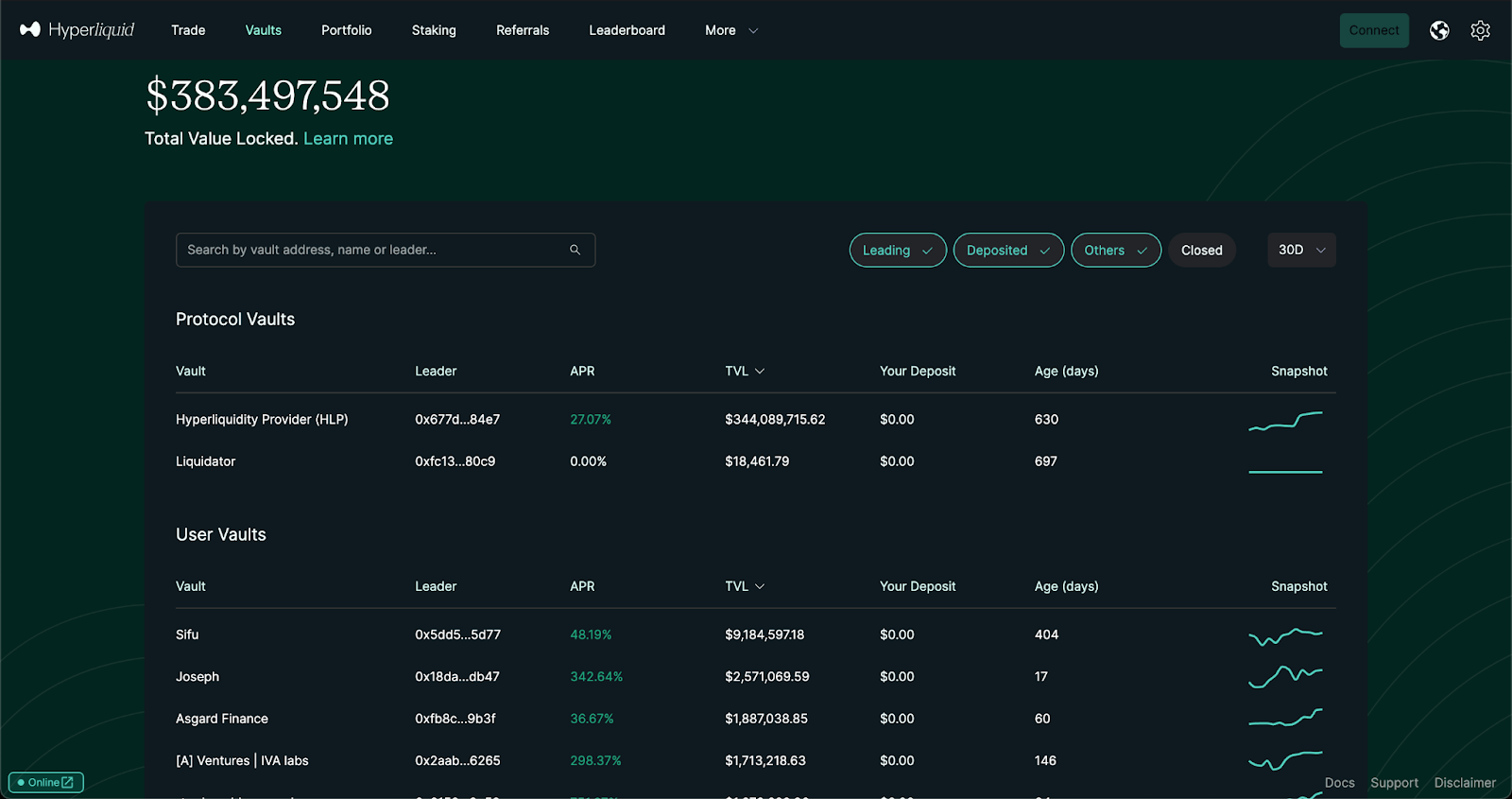
In addition to staking HYPE on the Hyperliquid blockchain, another way to earn yield via this DeFi app is by providing liquidity to the Hyperliquidity Provider (HLP) and other vaults. This liquidity allows traders to access price exposure to different crypto assets on the Hyperliquid DEX, and HLP depositors earn fees on these trades.
There may be multiple taxable events associated with providing liquidity.
Firstly, the act of providing liquidity to the HLP vault will likely be considered a sale of crypto assets that is subject to capital gains taxes, as those who provide liquidity to the HLP vault will need to do so via USD Coin (USDC) which is added to a pool of assets.
Secondly, the profits that are subsequently generated by the liquidity pool are subject to income taxes.
This is the most complex activity on Hyperliquid from a tax perspective, so assistance from a tax professional is recommended.
How bridging to and from Hyperliquid is taxed
All deposits to Hyperliquid are converted to USDC upon bridging.
So even if you deposit another stablecoin such as USDT, it will be converted to USDC once it arrives on Hyperliquid. This means any assets other than USDC will be swapped, which triggers a taxable event akin to any other crypto-to-crypto trade, and incur capital gains tax.
If you bridge USDC, then things may actually get a little more complicated, depending on your local tax laws.
If you are in a jurisdiction where bridging is not a taxable event, then depositing USDC should be straightforward.
However, if you are somewhere like the US, then you may need to adopt a conservative approach just to be safe. This is because the IRS has not yet provided clear guidance on whether bridging the same asset is a taxable event or not.
As such, tax professionals tend to recommend treating these bridge transactions like crypto trades, just to be safe.
This means a capital gains tax event would occur when a crypto asset is bridged to another blockchain. This interpretation of the tax code would also apply when bridging an asset back to its blockchain of origin.
That said, there are multiple perspectives on whether this kind of DeFi activity constitutes a taxable event, as some experts see no difference between an underlying crypto asset and derivative tokens that are issued on other blockchains. Consult a tax professional if you are unsure about how to report it on your taxes.
How the Hyperliquid airdrop is taxed
Airdrops became commonplace in crypto during the early 2020s as a more regulator-friendly alternative to initial coin offerings (ICOs). In an airdrop, early users of DeFi apps are rewarded with new crypto tokens related to the apps rather than investors receiving initial coin distributions.
Despite the fact that airdrops are not necessarily investments made by crypto users, the reality is there are still multiple potential areas of concern here in terms of taxation. When the airdrop is initially received by a user, this should be considered income from a tax perspective, and the user’s income tax obligations should be calculated at the time that the airdrop was received.
On top of the income tax concerns, recipients also need to consider potential capital gains tax obligations related to the sale of the airdrop rewards after they have been received.
Of course, potential taxation related to staking also needs to be considered if the HYPE tokens are staked. Additionally, these tax considerations also need to be made for any other types of reward tokens that could potentially be airdropped to Hyperliquid users in the future.
Sources
- Digital Assets, Internal Revenue Service, 2024
- Treasury, IRS issue final regulations requiring broker reporting of sales and exchanges of digital assets that are subject to tax under current law, additional guidance to provide penalty relief, address information reporting and other technical issues, Internal Revenue Service, 2024
- Protocol Vaults, Hyperliquid, 2025