How to do your Bybit taxes in 2025
Summ to to helps traders on Bybit easily calculate their cryptocurrency tax obligations. Users can now upload via a CSV import following the instructions in this guide.
 Summ
Summ If you’ve been using Bybit, it’s important to understand how to report your crypto taxes. Like most exchanges, Bybit does not automatically report, calculate, or issue tax forms for you. It’s up to users to report their gains, losses, and income from the platform.
The good news is that Summ makes calculating your Bybit taxes quick and easy by automatically importing your data and generating comprehensive tax reports.

Quick Steps
- Create an account on Summ or log in if you already have one.
- Select Bybit in the Accounts list.
- Import your Bybit transactions using API or CSV. More on each below.
- Let our software calculate your gains, losses, and income.
- Download your tax report and file it with your taxes.
Disclaimer: The information in this guide is general in nature and not written for a specific tax jurisdiction or audience.
Do I need to pay taxes on Bybit?
If you have been transacting on Bybit during the tax year, then it’s likely you will need to pay tax based on your trading activity.
Typically, anytime you sell crypto for fiat, trade crypto-to-crypto, or earn crypto income (e.g., through staking or rewards on Bybit), it is considered a taxable event in most countries.
The exact tax you owe (capital gains or income tax) will depend on your local regulations and the specifics of each transaction. Check our local tax guides for details on how cryptocurrency is taxed in your jurisdiction.
Do I have to pay tax if I only bought crypto on Bybit but didn’t sell?
In most parts of the world, you do not pay any tax when you purchase crypto.
It is only when you later dispose of that crypto – i.e., sell it or trade it for another asset – that a taxable event occurs.
What Bybit transactions are taxable?
The following are common transactions on cryptocurrency exchanges like Bybit that are relevant to tax:
| Event | Tax Implication |
|---|---|
| Selling crypto | Capital gains tax |
| Crypto-to-crypto swaps | Capital gains tax |
| Rewards from staking, interest, or yield | Income tax |
Most countries typically tax proceeds earned from selling investments differently from money earned as income. In crypto, you may be subject to both capital gains and income tax, depending on the nature of your transaction.
Capital Gains tax events on Bybit
Whenever you sell or make a crypto-to-crypto swap on Bybit, you are disposing of an asset.
- If the value of the crypto at the time of sale/trade is higher than when you acquired it, you have a taxable capital gain.
- If it’s lower, you have a capital loss (which can often be used to offset other gains).
Summ will automatically calculate these gains and losses for each trade using your imported transaction data. It will also account for fees according to your local tax rules.
Income tax on Bybit
If you received crypto as a reward on for activities such as staking, lending, or referral bonuses, those tokens are usually considered income.
- The value of the crypto at the time and date you received it needs to be reported as income.
- It also forms the cost basis if you later sell the asset.
- More: 5 practical tax tips to help Bybit users (and any crypto investor).
Summ will automatically categorize income tax events and treat them according to your local tax rules.
Where do I find Bybit tax forms?
Exchanges like Bybit do not provide tax forms with a neat breakdown of your tax obligations. This is because tax rules vary between countries and jurisdictions, requiring specialized software to handle additional complexities of crypto tax.
Additionally, any assets you transfer onto the platform will be missing an accurate cost basis.
Fortunately, you can connect your Bybit account to Summ via API or upload your transaction data using CSV.
Summ will then:
- Combine this data with any other accounts or wallets you connect.
- Provide you with an accurate tax report ready to submit to your tax agent, accountant, or local tax authority.
You can connect as many supported exchange accounts, wallets, or blockchains as you like, with reports available for all previous years on a single plan.
How to calculate Bybit taxes with Summ
1. Import your data
First, you will need to import your Bybit transaction data to Summ.
Here are the two main methods:
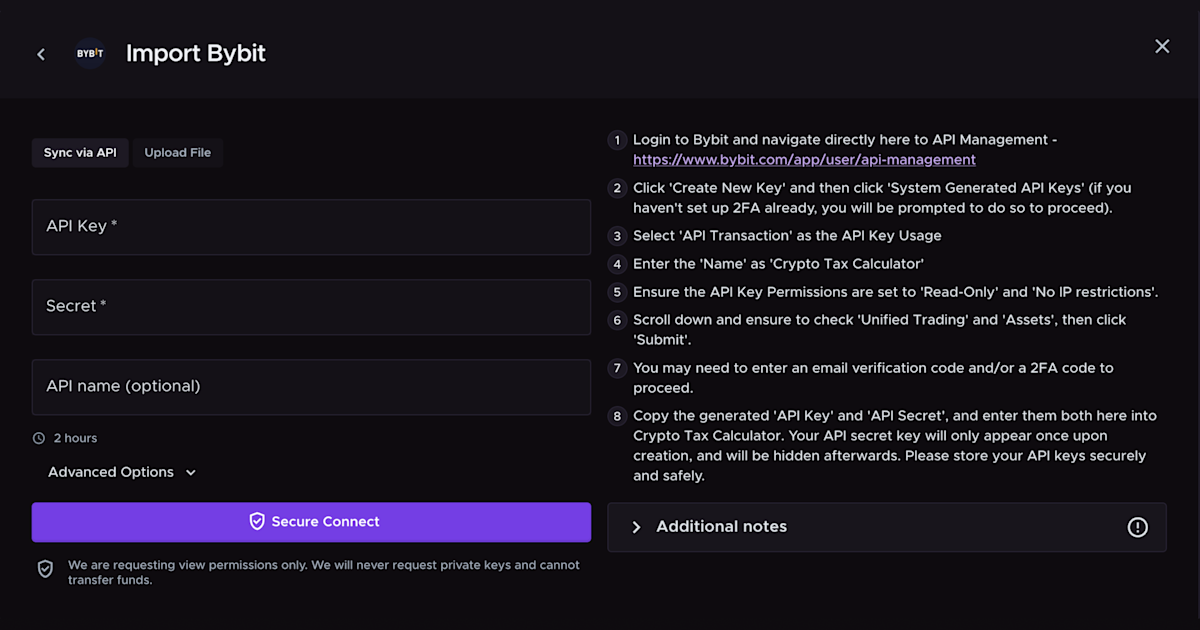
Automatic API Import
This method uses a secure API feed to transfer your transaction data to Summ. Using an API ensures that your data will be updated over time, so any change in your Bybit balance is reflected in Summ.
- Sign in to Summ or create an account.
- Navigate to the Accounts tab and click + Add accounts.
- Select Bybit from the list of exchanges. Click on Sync via API.
- Follow the instructions on the right-hand side to find your API key on Bybit.
- Input your API details and click Secure Connect.
- Once authorized, Summ will automatically import your Bybit transaction history.
- This may take a few seconds to a few minutes, depending on the number of transactions.
- You’ll see a confirmation when all data is imported.
CSV File Upload
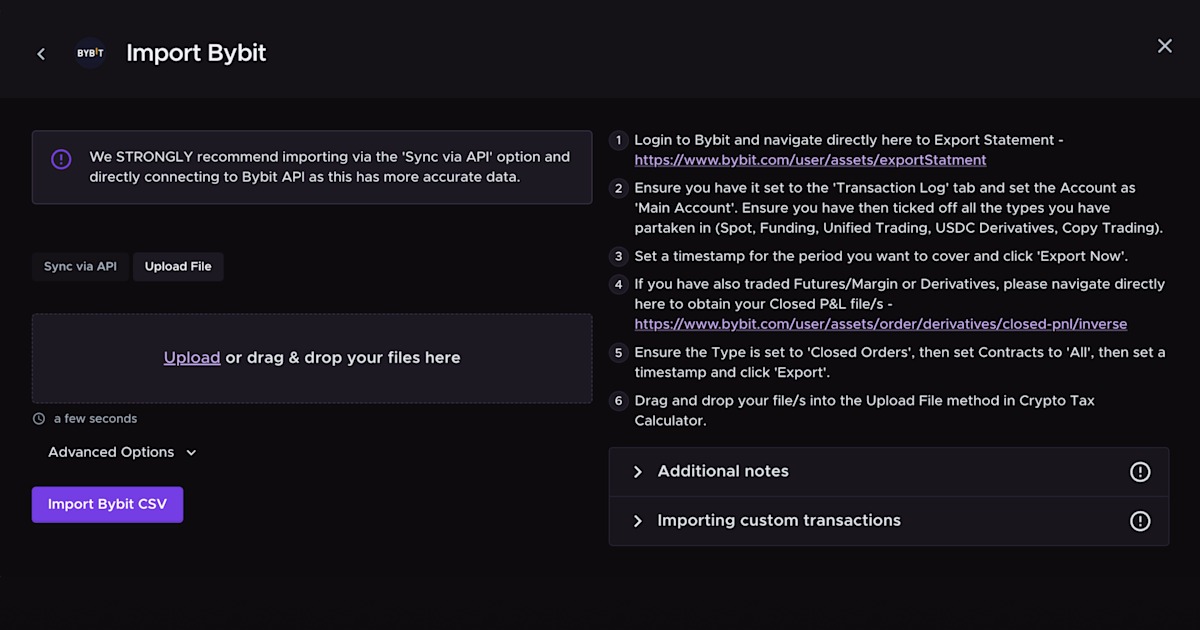
Not all exchanges provide easy API access; some users might prefer CSV uploads instead.
- Sign in to Summ or create an account.
- Navigate to the Accounts tab and click + Add accounts.
- Select Bybit from the list of exchanges. Click on Upload File.
- Follow the instructions on the right-hand side to find and download your transaction data on Bybit.
- Click Import Bybit CSV to upload your transaction data.
- Choose your file using the browser or drag and drop it into the window.
- Click Import Bybit CSV to complete the upload.
- Verify the data
- The software will parse the CSV and import all transactions.
- Double-check that the transaction details match your expectations from Bybit.
- Summ will alert you if any data seems missing or if there are errors in the file.
Note: Some exchanges split different types of transactions into multiple files or have separate histories for sub-accounts. Make sure to import all relevant files to cover your complete trading history.
2. Generate your tax report
Once your Bybit data is imported to Summ via API or CSV, you can calculate your taxes with just a few clicks.
Import accounts
- Add any other exchange accounts, wallets, or transaction data to Summ.
- You will need to upload your entire crypto transaction history for an accurate report.
Review transactions
- While Summ does the hard work for you, it may flag missing data or errors.
- You will need to review and verify the flagged transactions to ensure accuracy.
Get your tax report
- Generate a comprehensive tax report ready for your accountant or local tax authority.
If you're new to Summ, try our Getting Started Guide for an overview of how the platform works.
How to file your Bybit tax report
Here’s what to do with your exciting and new crypto tax report:
1. Review your tax report
After importing, you can generate a tax report for Bybit and any other accounts you linked. This report will detail your net capital gains, losses, and income from crypto for your chosen financial year.
- Review it to make sure everything looks correct.
- If something looks off, return to the Review tab to ensure all transactions are categorized correctly.
- Check the Accounts tab to ensure all your accounts and their transactions have been added.
2. Download and complete the necessary tax forms
Summ can produce specific forms or summaries needed for filing.
- If you live in the US, it can produce a report ready to upload to TurboTax.
- There are also specific forms like Form 8949 and Schedule D that contain the relevant information for crypto.
- Summ’s reports are designed to be tax-office compliant, making the process straightforward.
3. File before the deadline
Make sure you file your taxes before the deadline in your country.
- Properly reporting your Bybit crypto activity will keep you compliant and help you avoid any penalties.