All Countries

Thank you! Your submission has been received!
Oops! Something went wrong while submitting the form.
USA flag
Spain
No items found.
2025-04-01

How Investing vs Trading impacts tax

In most cases of buying and selling cryptocurrency as a retail investor, you are participating in investing rather than trading. The two are treated differently for tax purposes.

  • Investing is subject to capital gains tax or income tax, depending on the nature of the transaction.
  • Trading in this case refers to self-employment which is subject to income tax and National Insurance Contributions.

The key difference between investing and trading – along with the different tax treatments, is how losses generated in the crypto-activity can be used.

In their guidance, HMRC have explicitly stated that they would expect it to be exceedingly rare that any crypto-activity constituting buying & selling crypto would be classified as “trading”.

If you are uncertain, speak to a tax advisor as there are always exceptions, including but not limited to, developing tokens and large scale mining.

How is crypto tax calculated in the United States?

You can be liable for both capital gains and income tax depending on the type of cryptocurrency transaction, and your individual circumstances. For example, you might need to pay capital gains on profits from buying and selling cryptocurrency, or pay income tax on interest earned when holding crypto.

CoinLedger

CoinLedger is an accessible crypto tax platform with over 1,000 exchange and wallet integrations.

Best for: Users who want a simple, straightforward experience without complex DeFi needs.

Key differentiator: Offers an unlimited transaction plan for high-volume traders at a fixed price.

Pricing: $49 (100 transactions) to $499+ (10,000+ transactions).

Limitation: Does not generate Schedule D forms - you will need to complete this manually or with other software.

Notable: Strong NFT support with OpenSea integration.

CoinTracker

CoinTracker is a portfolio tracker and tax calculator supporting over 30,000 cryptocurrencies.

Best for: Users who prioritize portfolio tracking alongside tax reporting.

Key differentiator: Direct integrations with TurboTax and H&R Block Desktop.

Pricing: $59 (100 transactions) to $599 (10,000 transactions), with full-service options up to $3,499.

Limitation: Customer support is limited on lower-tier plans - priority support requires the $599 Ultra plan.

Notable: Good security with end-to-end encryption and SOC 2 compliance.

ZenLedger

ZenLedger offers both DIY crypto tax reports and professional full-service accounting.

Best for: Users who want tax loss harvesting included at every pricing tier.

Key differentiator: Tax loss harvesting is available on all plans, not just premium tiers.

Pricing: $49 (100 transactions) to $399 (15,000 transactions).

Limitation: Only offers 400+ exchange integrations - significantly fewer than competitors. Some users report customer support issues with long wait times.

Notable: TurboTax integration and 14-day refund policy.

blog
Apr 1
,
 
2025
 - 
10
min read

How is Bridging Crypto Taxed?

Wondering about the tax implications of bridging your crypto assets? We’ve got the answers for you in our blog.

Key takeaways
  • If bridging is considered a disposal by tax authorities, then it is a taxable event.
  • Software like Summ (formerly Crypto Tax Calculator) can help you record and calculate the taxes you owe from bridging crypto.
This tax guide is regularly updated: Last Update  

What is bridging?

Just as the name suggests, a blockchain bridge connects two different chains and allows assets to move from one to the other. Bridging is a relatively new transaction type that has been born out of necessity as more blockchains are created and DeFi users wish to move their assets from chain to chain to take advantage of different opportunities.

Bridging often consists of many different transactions and can even result in the change of the underlying asset to a pegged or wrapped derivative (depending on the bridge and source/destination chain). Summ (formerly Crypto Tax Calculator) can handle these complex transactions, allowing you to reconcile any cross-chain transactions and report your tax obligations correctly.

What are the tax implications of bridging?

Right now, there is a lack of specific guidance on the tax implications of bridging crypto assets from the majority of tax regulatory bodies around the world. This has led to two dominant schools of thought on the issue: those who see bridging as a taxable event (conservative), and those who do not (aggressive). Let’s dive in.

In most regions, a capital gains taxable event regarding crypto activity happens when there’s a ‘disposal’ of an owner’s asset. A disposal is defined as a change of ownership in a specific asset; for example, when selling ETH for BTC. The seller is ‘disposing’ of their ETH to receive BTC in return.

The conservative approach:

For those who classify bridging as a taxable event, they view the bridging event itself as a disposal. When transferring a crypto asset cross-chain, they believe that this asset has left the beneficial ownership of it’s original holder when making this journey. The discussion hinges on the argument that moving assets across fundamentally different blockchains might be considered creating materially different assets, accompanied by the argument that by granting the smart contract the ability to make this cross-chain journey, the owner is giving up ownership over their assets.

The aggressive approach:

In the aggressive approach, it is argued that because of the lack of guidelines available from your tax regulatory body, bridging is the equivalent of transferring crypto between two wallets owned by the same user. You would argue that, as a result, this doesn’t constitute a disposal event, and as such, you wouldn’t incur capital gains tax.

We recommend that you work with a local tax professional to decide what approach is best for your personal circumstances.

{{bridging-crypto-tax-cta1}}

How can Summ help?

Handling Bridging in the Platform

To handle bridging using Summ, follow these simple steps:

  1. Find the transactions related to the bridging event under ‘Review Transactions’. Usually they will be split into an ‘outgoing’ component (sending to the bridge) and an ‘incoming’ component (receiving the asset on the other chain). The example below shows 0.5 WETH being bridged from Ethereum to Avalanche.

bridging-step1.png
  1. Re-categorize the ‘outgoing’ component as ‘Bridge Out’. Do this by clicking on the category box, selecting ‘Advanced’ and then choose the category ‘Bridge Out’ on the right side of the page.

bridging-step2.png
  1. Re-categorize the ‘incoming’ component as ‘Bridge In’ using the same process as step 2.
  2. The two components will then group to form a single line categorized as a ‘Bridge’. The cost basis from the original asset will be moved across to the asset on the destination chain, even if it is a pegged or wrapped version of the original asset.
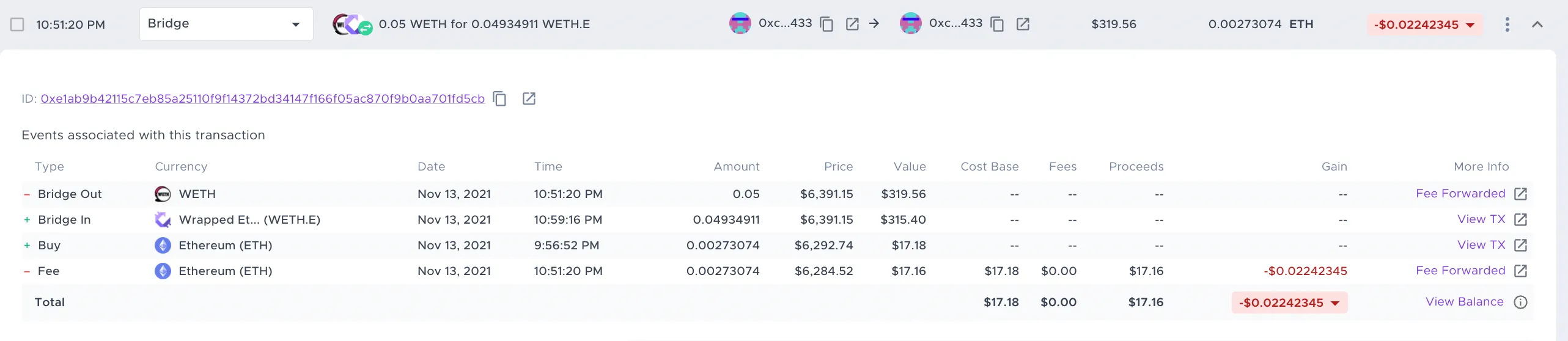
bridging-step4.png

Important Notes

  • Both the ‘Bridge Out’ and ‘Bridge In’ components must occur within a 24 hour timeframe for them to be grouped together.
  • A ‘Bridge Out’ will match with the next ‘Bridge In’ in chronological order if the following criteria are fulfilled:
    • The two components are within 24 hours
    • The amount that is received is similar to the amount that was sent (5% tolerance accepted)
  • If multiple bridges of the same amount are done in the same 24 hours, ensure that the corresponding ‘Bridge Out’ and ‘Bridge In’ are chronologically one after the other.
  • Bridging transactions will not be auto-categorized, they require manual selection due to the complex nature of the transaction.
  • The cost basis of the original asset on the source chain will be transferred to the asset that is received on the destination chain whether it is the same asset or a pegged/wrapped version.
Guía de Impuestos NFT
¿Probó suerte en el comercio de NFT? Esta guía completa desglosa los detalles de los impuestos NFT en EE. UU. para que pueda presentar su declaración con confianza.
Guía Fiscal Española
¿No estás seguro de tus obligaciones tributarias sobre las criptomonedas? Esta guía completa lo ayuda a comprender y presentar sus impuestos sobre criptomonedas en EE. UU.
Guía de Impuestos de DeFi
¿Has estado incursionando con DeFi? Esta guía detallada desglosa los detalles de los impuestos DeFi para que pueda presentar su declaración con confianza.
Understanding the different tax reports available
Managing and inviting clients
Ways of working with clients: Full service, collaboration, and self-service
Using different inventory methods

The information provided on this website is general in nature and is not tax, accounting or legal advice. It has been prepared without taking into account your objectives, financial situation or needs. Before acting on this information, you should consider the appropriateness of the information having regard to your own objectives, financial situation and needs and seek professional advice. Summ (formerly Crypto Tax Calculator) disclaims all and any guarantees, undertakings and warranties, expressed or implied, and is not liable for any loss or damage whatsoever (including human or computer error, negligent or otherwise, or incidental or Consequential Loss or damage) arising out of, or in connection with, any use or reliance on the information or advice in this website. The user must accept sole responsibility associated with the use of the material on this site, irrespective of the purpose for which such use or results are applied. The information in this website is no substitute for specialist advice.

FAQ

No items found.
Table of contents
heading2
heading3

More resources

CryptoTax Calculator thumbnail
Blog
3
 
Jun
 
2026
Cómo declarar tus operaciones de Binance en el Modelo 100

Binance es el exchange más utilizado en España, y también el más complejo de declarar. Esta guía explica qué operaciones tributan y cómo se asignan a las casillas del Modelo 100.

Read More
CryptoTax Calculator thumbnail
Blog
25
 
May
 
2026
Cómo declarar los airdrops de criptomonedas en España (Casilla 0304)

Una guía práctica sobre cómo se declaran habitualmente los airdrops de criptomonedas en el IRPF en España: en qué apartado del Modelo 100 encajan, cómo se valúan, los tipos aplicables y cómo el valor del airdrop afecta al cálculo de las ganancias patrimoniales futuras.

Read More
CryptoTax Calculator thumbnail
Blog
18
 
May
 
2026
Impuestos DeFi en España: pools de liquidez, yield farming y swaps de tokens

El rincón más complejo de la fiscalidad cripto en España. Esta guía explica cómo se suele tributar la actividad DeFi en España: pools de liquidez, yield farming, lending, swaps en DEX y cómo asignar cada actividad al apartado correspondiente del Modelo 100.

Read More

Comience gratis

Importe sus transacciones y genere una vista previa del informe gratuita.

Blog

24 June 2022

X

 Min read

How is Bridging Crypto Taxed?

Wondering about the tax implications of bridging your crypto assets? We’ve got the answers for you in our blog.

Shane Brunette

Key takeaways

  • If bridging is considered a disposal by tax authorities, then it is a taxable event.
  • Software like Summ (formerly Crypto Tax Calculator) can help you record and calculate the taxes you owe from bridging crypto.

This tax guide is regularly updated: Last Update 

....

April

1

2025

What is bridging?

Just as the name suggests, a blockchain bridge connects two different chains and allows assets to move from one to the other. Bridging is a relatively new transaction type that has been born out of necessity as more blockchains are created and DeFi users wish to move their assets from chain to chain to take advantage of different opportunities.

Bridging often consists of many different transactions and can even result in the change of the underlying asset to a pegged or wrapped derivative (depending on the bridge and source/destination chain). Summ (formerly Crypto Tax Calculator) can handle these complex transactions, allowing you to reconcile any cross-chain transactions and report your tax obligations correctly.

What are the tax implications of bridging?

Right now, there is a lack of specific guidance on the tax implications of bridging crypto assets from the majority of tax regulatory bodies around the world. This has led to two dominant schools of thought on the issue: those who see bridging as a taxable event (conservative), and those who do not (aggressive). Let’s dive in.

In most regions, a capital gains taxable event regarding crypto activity happens when there’s a ‘disposal’ of an owner’s asset. A disposal is defined as a change of ownership in a specific asset; for example, when selling ETH for BTC. The seller is ‘disposing’ of their ETH to receive BTC in return.

The conservative approach:

For those who classify bridging as a taxable event, they view the bridging event itself as a disposal. When transferring a crypto asset cross-chain, they believe that this asset has left the beneficial ownership of it’s original holder when making this journey. The discussion hinges on the argument that moving assets across fundamentally different blockchains might be considered creating materially different assets, accompanied by the argument that by granting the smart contract the ability to make this cross-chain journey, the owner is giving up ownership over their assets.

The aggressive approach:

In the aggressive approach, it is argued that because of the lack of guidelines available from your tax regulatory body, bridging is the equivalent of transferring crypto between two wallets owned by the same user. You would argue that, as a result, this doesn’t constitute a disposal event, and as such, you wouldn’t incur capital gains tax.

We recommend that you work with a local tax professional to decide what approach is best for your personal circumstances.

{{bridging-crypto-tax-cta1}}

How can Summ help?

Handling Bridging in the Platform

To handle bridging using Summ, follow these simple steps:

  1. Find the transactions related to the bridging event under ‘Review Transactions’. Usually they will be split into an ‘outgoing’ component (sending to the bridge) and an ‘incoming’ component (receiving the asset on the other chain). The example below shows 0.5 WETH being bridged from Ethereum to Avalanche.
bridging-step1.png
  1. Re-categorize the ‘outgoing’ component as ‘Bridge Out’. Do this by clicking on the category box, selecting ‘Advanced’ and then choose the category ‘Bridge Out’ on the right side of the page.
bridging-step2.png
  1. Re-categorize the ‘incoming’ component as ‘Bridge In’ using the same process as step 2.
  2. The two components will then group to form a single line categorized as a ‘Bridge’. The cost basis from the original asset will be moved across to the asset on the destination chain, even if it is a pegged or wrapped version of the original asset.
bridging-step4.png

Important Notes

  • Both the ‘Bridge Out’ and ‘Bridge In’ components must occur within a 24 hour timeframe for them to be grouped together.
  • A ‘Bridge Out’ will match with the next ‘Bridge In’ in chronological order if the following criteria are fulfilled:
    • The two components are within 24 hours
    • The amount that is received is similar to the amount that was sent (5% tolerance accepted)
  • If multiple bridges of the same amount are done in the same 24 hours, ensure that the corresponding ‘Bridge Out’ and ‘Bridge In’ are chronologically one after the other.
  • Bridging transactions will not be auto-categorized, they require manual selection due to the complex nature of the transaction.
  • The cost basis of the original asset on the source chain will be transferred to the asset that is received on the destination chain whether it is the same asset or a pegged/wrapped version.

Discover savings opportunities and lower your tax with Summ

Get started for free

No se necesita una tarjeta de crédito

Track all your swaps, trades and DeFi activity with Summ for easy tax reporting

Get started for free

No se necesita una tarjeta de crédito

Struggling with your tax?

Let Summ do the hard work for you.

Select country

Connect accounts

Get tax report

Get started for free

No se necesita una tarjeta de crédito

Automate your record keeping with Summ

Get started for free

No se necesita una tarjeta de crédito

Get started for free

No se necesita una tarjeta de crédito

Preguntas frecuentes

¿Cómo se calcula el impuesto a las criptomonedas?

Puede ser responsable tanto de las ganancias de capital como del impuesto sobre la renta según el tipo de transacción de criptomonedas y sus circunstancias individuales. Por ejemplo, es posible que deba pagar ganancias de capital sobre las ganancias obtenidas por la compra y venta de criptomonedas, o pagar impuestos sobre la renta sobre los intereses obtenidos al mantener criptomonedas.

¿Cómo puede ayudar Summ con los impuestos sobre criptomonedas?

Solo necesita importar su historial de transacciones y lo ayudaremos a categorizar sus transacciones y calcular las ganancias y los ingresos obtenidos. Luego puede generar los informes apropiados para enviarlos a su contador y mantener registros detallados a mano para fines de auditoría.

¿Manejas actividades no cambiarias?

Manejamos todas las actividades que no son de intercambio, como transacciones en cadena como Airdrops, Stake, Minería, ICO y otras actividades de DeFi. No importa qué actividad haya realizado en criptografía, lo cubrimos con nuestra función de categorización fácil de usar, similar a Expensify.

¿Qué pasa si mi intercambio no está en la lista de intercambios admitidos?

Cubrimos cientos de intercambios, billeteras y cadenas de bloques, pero si no ve su intercambio en la lista admitida, estaremos encantados de trabajar con usted para que lo admita. Simplemente comuníquese con [email protected] o mediante la función de soporte por chat en la aplicación y lo solucionaremos.

¿Cómo funciona la prueba gratuita?

La plataforma es de uso gratuito inmediatamente después de registrarse, lo que le permite importar sus transacciones y aprovechar nuestro motor inteligente de sugerencias y categorización automática, seguimiento de cartera y soporte DeFi y NFT. Para acceder a los informes, la herramienta de recolección de pérdidas fiscales o el chat y soporte prioritario, deberá actualizar al plan pago correspondiente.

Automatiza tu contabilidad criptográfica

01

Sincronizar y centralizar transacciones

Importe desde más de 1000 fuentes. Centralice su actividad criptográfica y ahorre el valioso tiempo que normalmente se dedica al seguimiento de transacciones en varias plataformas.
02

Etiquetado, reglas y conciliación automatizados

We conduct regular and thorough Security & Awareness training for all employees.
03

Full data privacy

Our application only ever requires 'read-only' access to your data.