

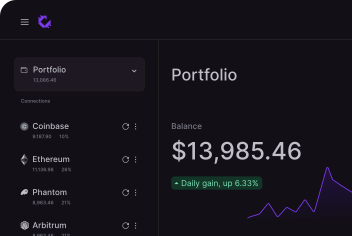

Use Summ (formerly Crypto Tax Calculator) and save yourself the hassle at tax time. Get your taxes done in just a few clicks, instead of days, and receive a compliant tax report ready for the ATO or your tax agent.














































































































































































































































































































































































































































































































Investing in crypto assets can be rewarding, but you need to understand the Australian tax implications. The Australian Taxation Office (ATO) applies existing tax legislation to crypto transactions, and given the unique nature of crypto activities, tax liabilities may not always be obvious. This guide explains the tax rules, walks through common scenarios, and shows how to report your activity. Your actual tax liability depends on the type of asset, the activities you engage in, and whether those activities are part of a business.
What is capital gains tax?
Overview
The capital gains tax (CGT) regime taxes profits made on particular assets and rights (CGT assets) during an income year. CGT is not a separate tax in Australia. Instead, CGT affects your income tax liability because your assessable income includes net capital gains from the income year.
Here's the formula:
Net Capital Gain = Capital Gains – Capital Losses
If you have a net capital gain from crypto assets, you add that gain to your total assessable income and pay tax at your marginal tax rate. This can push you into a higher tax bracket.
Are crypto assets CGT assets?
Yes. In 2014, the ATO issued a public ruling confirming that bitcoin is a CGT asset for Australian taxation purposes. This ruling extends to all crypto assets. When you dispose of crypto, you trigger a CGT event and must calculate your gain or loss.
What are capital gains?
A capital gain is the profit you make when you dispose of a CGT asset for more than its cost base. The cost base is what you paid to acquire the asset, including transaction fees (like exchange fees).
Example: You buy 1 BTC for AUD $60,000 (including fees). Two years later, you sell it for AUD $85,000. Your capital gain is AUD $25,000.
What are capital losses?
A capital loss occurs when you dispose of a CGT asset for less than its cost base. Capital losses can offset capital gains in the same income year. If your losses exceed your gains, you cannot offset your salary, wages, or other ordinary income. However, unused losses carry forward to future income years and can offset capital gains in those years.
Wash sale warning: The ATO actively targets wash sales, where investors sell crypto to crystallise a loss and immediately rebuy the same or substantially similar asset. If you sell to realise a loss and then repurchase the same crypto shortly after, the ATO may cancel your loss claim. Be cautious about timing losses strategically near year-end.
How to report your crypto asset activity
Lodgment dates for FY2026
The financial year 2026 runs from 1 July 2025 to 30 June 2026. Lodgment deadlines are:
- Individuals: 31 October 2026
- Tax agents: Follow the Tax Agent Lodgment Program (can be as late as 31 May 2027)
The ATO expects you to lodge earlier if you use a tax agent, as processing takes time.
Lodging your tax return online
To lodge your tax return, log into myGov, connect to the ATO, navigate to Tax, then Income Tax, then Lodgments. Your crypto transactions are reported in the same section as other capital gains and income.
You'll need to declare:
- All capital gains from crypto disposals
- All capital losses
- Any income from staking, mining, airdrops, or services rendered in crypto
- Personal use asset exemptions (if applicable)
If you have complex activity across multiple exchanges or wallets, a tax agent or crypto tax software can help ensure you don't miss anything.
Calculating your crypto taxes with Summ
Calculating tax on dozens or hundreds of transactions by hand is error-prone and time-consuming. Summ is designed to automate this for Australian investors.
Here's how it works:
- Connect your data. You can copy-paste public wallet addresses or connect to exchanges via CSV file or API integration. Summ never stores your private keys or personal data.
- Summ auto-categorises transactions. Buys, sells, staking rewards, chain splits, airdrops, NFT mints, and more are automatically sorted into the right tax category.
- Generate your reports. Summ produces three key reports: Report Summary (overview of all gains, losses, and income), Income Report (staking rewards, mining income, airdrops, and other income-taxable events), and Miscellaneous Expenses Report (transaction fees you can claim as deductions).
- Lodge with confidence. Take your reports to your accountant or lodge directly using the figures in your Summ report. The calculations are ready for the ATO.
By using Summ, you avoid manual spreadsheet errors and ensure you're following ATO guidance on every transaction type. Learn more about Summ or start your free report today.
Examples of crypto asset activities and their taxation
Below are the most common crypto activities and how Australian tax law treats them.
Acquiring crypto assets
Airdrops and initial allocation airdrops
An airdrop is when a blockchain project distributes tokens to wallet holders. There are two types:
Established token airdrops: If you receive an airdrop of an established token (one already trading on exchanges), it's ordinary income. You must declare it at the market value on the date you received it. This is assessed as income in your tax year.
Example: You receive 10 USDC via airdrop when the market price is AUD $15 per token. You must declare AUD $150 as income, even if you haven't sold the tokens.
Initial allocation airdrops: If the airdrop is from a token in its initial phase (not yet trading), the ATO treats it differently. You don't declare it as income at receipt, and you don't calculate a capital gain just from receiving it. Instead, your cost base for those tokens is the amount you paid (or zero if it was free). When you later sell or dispose of those tokens, you calculate CGT based on the difference between your cost base and the sale price.
Receipts from staking
Staking rewards are ordinary income. When you receive rewards, you must declare them at the market value on the day you received them, not the day you bought or sold them. This is the ATO's current position and it applies even if you don't immediately sell the rewards.
Example: You stake 10 ETH and receive 0.5 ETH in rewards when ETH is worth AUD $3,000 per token. You declare AUD $1,500 as income. Later, when you sell that 0.5 ETH for AUD $4,000, you calculate a capital gain of AUD $2,500 (AUD $4,000 minus your cost base of AUD $1,500).
If you stake via a pool or platform, the same rule applies. Record the date and market value of each reward.
Mining
Whether you mine cryptocurrency as a hobby or run it as a business changes how the ATO taxes you, and the line between the two is not always obvious.
For hobby miners, each coin you receive is treated as a capital gains event when you later dispose of it. Your cost base is the market value of the coin on the day you received it. If you hold for more than 12 months before selling, you can apply the 50% CGT discount.
For business miners, the coins are treated as trading stock or ordinary income. The ATO applies several criteria to determine which side of the line you fall on: commercial intent and a genuine profit motive, whether you operate in a business-like way with systems and records, the regularity and scale of the activity, and whether you have made a material investment in equipment such as ASICs or GPU rigs. No single factor is decisive — the ATO looks at the overall picture.
The practical difference matters. Business miners can deduct electricity, hardware depreciation, and other operating costs against income. Hobby miners cannot. If you operate as a business, you should recategorise your mining rewards as income in Summ rather than leaving them as capital acquisitions: go to the relevant transactions, change the transaction type to Mining Income, and Summ will apply income tax treatment and include the amounts in your income report. If you are uncertain which category applies to you, an accountant familiar with crypto is worth consulting before you lodge.
Chain splits and hard forks
A chain split (also called a hard fork) is when a blockchain creates a new version and new tokens. An example is the 2017 Bitcoin split that created Bitcoin Cash.
When you receive new tokens from a chain split, those tokens have a zero cost base. There is no taxable event at the time of the split — the ATO's position is that receiving forked coins is not assessable income. When you later sell or dispose of them, you calculate a capital gain or loss based on the market value at the time of sale versus that zero cost base.
Example: During a chain split, you receive 1 new token worth AUD $5,000. Your cost base is AUD $0. If you sell it for AUD $6,000, your capital gain is AUD $6,000.
Your original holdings are unaffected. The cost base and acquisition date of your pre-fork coins do not change. The practical implication: receiving forked coins looks cost-free at the time, but there is a deferred tax liability sitting in them. If you receive a large forked allocation and the asset appreciates significantly before you sell, the entire gain is taxable from a zero base.
Salary and wages paid in crypto assets
If your employer pays you in crypto, that payment is assessed as income at the Australian dollar value on the day you received it. You pay income tax on the AUD value, not on any future gains or losses in the crypto asset itself.
Example: Your employer pays you 0.1 BTC as part of your salary when BTC is worth AUD $60,000. You must declare AUD $6,000 as employment income. Later, if you sell that BTC for AUD $7,000, you have a capital gain of AUD $1,000.
Your cost base for CGT purposes is the AUD value on the day of receipt (AUD $6,000 in this example).
Receiving crypto assets for services rendered
This is the same as salary. If you provide a service (freelance work, consulting, etc.) and receive crypto as payment, you must declare the AUD value on the day you received it as ordinary income.
Example: You invoice a client AUD $5,000 for a design project and they pay you in USDC stablecoin worth AUD $5,000 on the day of receipt. You declare AUD $5,000 as income.
Receiving and giving a gift of crypto assets
Receiving a gift: There is no income tax on receiving a gift of crypto. However, your cost base for CGT purposes is the market value of the asset on the day you received it, not what the giver paid for it.
Example: A friend gives you 1 ETH when it's worth AUD $3,000. Your cost base is AUD $3,000, even if your friend paid AUD $2,000 for it. If you later sell it for AUD $4,000, your capital gain is AUD $1,000.
Giving a gift: When you give away crypto, you trigger a CGT event. You must calculate a capital gain or loss at the market value on the day of the gift.
Example: You gift 1 BTC to a friend when it's worth AUD $70,000. You originally bought it for AUD $50,000. You must declare a capital gain of AUD $20,000, even though you received no money in return.
Initial coin offerings
When you buy tokens in an Initial Coin Offering (ICO), you're acquiring a CGT asset. Your cost base is the amount you paid (including transaction fees). When you later sell or dispose of those tokens, you calculate CGT on the gain or loss. Income tax may apply separately if the tokens are a business or investment income rather than a passive investment.
Using crypto assets
Personal use assets
There's a special exemption for personal use assets. If you acquire crypto for less than AUD $10,000 and use it mainly for personal purchases (not investment), you may be exempt from CGT when you dispose of it. The longer you hold the asset and the more you focus on investment rather than personal use, the less likely this exemption applies.
Example: You buy AUD $8,000 of ETH and use it exclusively to pay for online services and purchases over 6 months. You then sell it for AUD $9,000. You may qualify for the personal use exemption and not declare the AUD $1,000 gain. However, if you held it for 3 years hoping the price would rise, it's likely an investment asset and the exemption doesn't apply.
This exemption is narrow. The ATO looks at your intent and use. Document what you used the crypto for (receipts, transaction records).
Loaning your cryptocurrency
If you loan crypto to someone else but retain ownership and beneficial interest, it's not a CGT event. You still own the asset and will receive it back. However, if you receive interest or fees for the loan, that's ordinary income and must be declared.
Example: You loan 1 BTC to a friend who agrees to pay you 5% annual interest in BTC. When you receive the interest payments, that's ordinary income at the market value on the date received.
If you cannot get the loan repaid, you may be able to claim a capital loss if the asset is genuinely lost.
Crypto assets, gift cards, and debit cards
If you convert crypto to load a crypto debit card or gift card (e.g., converting USDC to a card balance), that's a disposal of the crypto. You trigger a CGT event on the market value at the time of conversion.
Example: You convert 1,000 USDC to load a debit card when USDC is worth AUD $1.00 each. You declare AUD $1,000 as a disposal. Your cost base depends on when you acquired the USDC.
When you then spend from the card on personal purchases, there's no further CGT event (it's just spending the money you already paid tax on).
Transferring cryptocurrency between your wallets
Moving crypto from one wallet to another (whether on an exchange or your own cold wallet) is not a CGT event. You're not disposing of the asset; you're just moving it. No gain or loss is calculated.
Example: You transfer 1 BTC from Binance to your hardware wallet. No CGT event occurs. Your cost base remains unchanged.
However, if fees are charged for the transfer, those fees may be deductible as miscellaneous expenses if they relate to managing your income or CGT assets.
Margin trading, derivatives, and contracts for difference
Margin trading, futures, and CFDs are complex instruments. The CGT treatment depends on whether you hold the asset outright or are trading derivatives.
Crypto CFDs and futures: If you trade CFDs or futures (contracts that reference crypto but don't give you the underlying asset), each contract trade is a separate CGT event. You calculate gain or loss on each trade. This can trigger many small CGT events.
Margin trading (borrowing to buy): If you borrow money to buy crypto on margin, you own the underlying asset. You calculate CGT on disposal of that asset. The interest on the loan is a deductible expense.
Keep detailed records of every trade, including the date, price, and settlement date. Margin trading can generate many transactions and high tax complexity.
Perpetual contracts
Crypto perpetual contracts — also called perpetual swaps — are derivatives without an expiry date that track the spot price of an underlying asset. The ATO has not issued specific guidance on perpetuals, so how they should be taxed involves a degree of interpretation. In the absence of clear rulings, different practitioners take different positions.
Summ's default is a conservative realised-PnL approach: a taxable event occurs when you close a position, not while it is open. The gain or loss is calculated as the difference between your entry and exit price, converted to AUD at the time of each trade. This is the most defensible position given the current guidance gap.
Funding rates are where industry practice varies most. Summ treats received funding payments as ordinary income and paid funding rates as a deductible expense, recording them independently from the position's gain or loss. Some practitioners argue that funding rates should be netted against position PnL rather than treated as separate income and expense items. The ATO has not ruled on this. If you are trading at volume, getting specific advice on which treatment to apply — and documenting your reasoning — is worth doing before you lodge.
Mark-to-market accounting — where unrealised gains on open positions are included in taxable income each year — is used by some professional traders but is not Summ's default. Applying it requires a clear basis and carries risk if the ATO disagrees with your classification.
Wrapped tokens and bridging
Wrapped tokens (like Wrapped Bitcoin, WBTC) are crypto assets that represent another asset locked in a smart contract. Wrapping BTC into WBTC (or vice versa) is likely a disposal of one CGT asset and acquisition of another.
Example: You wrap 1 BTC into 1 WBTC. You trigger a CGT event on your BTC. If your BTC cost base was AUD $60,000 and BTC is worth AUD $70,000, you declare a AUD $10,000 capital gain. Your cost base for WBTC is now AUD $70,000 (the market value at the time of wrapping).
Similarly, bridging assets from one blockchain to another (e.g., ETH from Ethereum to Polygon) is typically a disposal. Record the exact date and price of the conversion.
Decentralised finance and lending arrangements
DeFi activities can involve complex tax treatment. The main scenarios:
Lending to a smart contract: If you deposit crypto into a lending protocol and retain ownership (the smart contract returns your exact tokens), it's not a disposal. However, any interest or rewards you receive are ordinary income. If the protocol cannot return your tokens (because it fails or is hacked), you may claim a capital loss.
Liquidity pools: Depositing assets into a liquidity pool to earn fees is likely a disposal of your original tokens and acquisition of LP tokens (a new asset). You have a CGT event at the market value on the date of deposit. When you withdraw, you trigger another CGT event. LP rewards are ordinary income.
Yield farming: Yield farming involves lending, borrowing, or trading across protocols to earn returns. Each transaction (deposit, trade, withdrawal) is typically a separate CGT event. Keep detailed records.
Staking derivatives: Some protocols issue staking derivatives (e.g., you stake ETH and receive stETH). The issuance of the derivative is a disposal, and the derivative is a new CGT asset. When you redeem or sell the derivative, you trigger another CGT event.
DeFi can create many small transactions. Use Summ to categorise and record every event accurately.
Disposing of crypto assets
Crypto to fiat currency
Selling crypto for AUD is the most straightforward CGT event. Calculate your gain or loss as the difference between the AUD sale price and your cost base.
Example: You bought 1 BTC for AUD $60,000. You sell it for AUD $85,000. Your capital gain is AUD $25,000. You declare this on your tax return.
Your capital gain is calculated at the AUD market value on the day of sale, regardless of when you bought or the price you paid.
Crypto to crypto transactions
Selling one crypto for another (e.g., BTC for ETH) is also a CGT event. You calculate gain or loss on the crypto you sold, using the AUD market value at the time of the trade.
Example: You swap 1 BTC (cost base AUD $60,000) for ETH when BTC is worth AUD $70,000. You declare a capital gain of AUD $10,000 on the BTC. Your cost base for the ETH is AUD $70,000 (the market value at time of acquisition).
Stablecoin swaps (e.g., USDC to USDT) are also CGT events, even though both are stable. Use the AUD market value at the time of the swap.
The 50% capital gains tax discount
If you hold a CGT asset for 12 months or more before disposal, you qualify for the CGT discount. Only 50% of your capital gain is taxable.
Example: You buy 1 BTC for AUD $60,000 on 1 July 2025. You sell it for AUD $80,000 on 1 August 2026 (13 months later). Your capital gain is AUD $20,000. With the 50% discount, only AUD $10,000 is taxable. You add AUD $10,000 to your assessable income and pay tax at your marginal rate.
The 12-month holding period must be unbroken. If you dispose of the asset and rebuy the same asset before 12 months, the holding period resets.
The CGT discount applies only to individuals and some trusts. Companies do not qualify.
Lost or stolen cryptocurrency
If your crypto is genuinely lost or stolen, you can claim a capital loss. Your loss is calculated as the market value on the date of loss or theft, minus your cost base.
Example: You bought 1 BTC for AUD $60,000. Your wallet is hacked and the BTC is stolen when it's worth AUD $65,000. Your capital loss is based on your cost base — AUD $60,000 — not the current market value.
The ATO's position on these claims is cautious. You cannot simply write off a loss by declaring coins missing — the evidentiary standard is higher than most people expect, and the ATO scrutinises these claims.
For lost crypto (forgotten seed phrases, lost hardware wallets, inaccessible exchange accounts), the ATO generally does not allow a capital loss unless you can demonstrate the asset is permanently unrecoverable. The evidence required includes: proof of ownership (original acquisition records showing you held the asset), the date of loss, the wallet address or exchange account involved, and written confirmation that you no longer have access to the private key or seed phrase controlling the funds. Keeping these records at the time of the loss — rather than reconstructing them years later — substantially strengthens your position.
For stolen crypto, the evidentiary bar is similar but differs in one key respect: you need to show the assets left your control without your authorisation. Useful documentation includes a police report, proof of ownership, transaction records or blockchain data showing the assets moving from your wallet address, wallet addresses involved in the theft, and any communication with exchanges or wallets where the incident occurred.
To claim the capital loss in Summ, locate the relevant transaction, change the transaction type to Lost or Stolen, and enter the date and AUD value at the time of loss. Summ will calculate the capital loss and include it in your CGT summary and tax report. Keep the supporting documentation — acquisition records, police reports, wallet correspondence — outside the platform where you can produce it if the ATO asks.
Moving crypto assets to an exchange
If you move crypto from a cold wallet to an exchange (to prepare to sell), it's not a CGT event. You still own the asset; you're just moving it to a new location. No gain or loss is calculated until you actually dispose of the asset on the exchange.
Cost basis methods
Your cost basis method determines which purchase price is matched against each sale. The choice can meaningfully affect how much tax you pay, so it is worth understanding before you generate your report.
The ATO defaults to FIFO (first in, first out), which assumes you sell your earliest-acquired coins first. This is the most conservative method in a rising market and the one the ATO expects you to use unless you have a valid basis for doing otherwise.
Other methods include:
- LIFO (last in, first out): matches each sale against your most recent acquisition. Can reduce taxable gains if your later purchases were at higher prices.
- HIFO (highest in, first out): matches each sale against your highest-cost acquisition. Tends to produce the lowest taxable gain, but requires accurate records for every individual lot.
- AVCO (average cost): uses the weighted average cost of all holdings to calculate the cost base for each disposal.
- Specific identification: lets you nominate exactly which parcel of coins is being sold. Requires granular per-lot records.
One important restriction: if the ATO determines you are operating as a trader rather than an investor, the 50% CGT discount does not apply, and your cost basis options narrow to FIFO or AVCO. LIFO, HIFO, and specific identification are not available to traders.
You must apply your chosen method consistently — you cannot switch between methods year to year to optimise your position. To change your cost basis method in Summ, go to Settings, select Tax Settings, and choose your preferred method from the Cost Basis Method dropdown. Summ will recalculate your gains and losses across all transactions using the new method, and you can compare the tax outcome before confirming.
Guidelines for particular crypto assets
Non-fungible tokens (NFTs)
NFTs are treated as CGT assets, just like crypto. The same rules apply to buying, holding, and selling NFTs.
Acquiring NFTs: When you mint or buy an NFT, your cost base is the amount you paid in AUD (including gas fees, auction fees, etc.). If you receive an NFT as an airdrop and it's an established NFT (a known project with a clear market price), it's ordinary income at market value. If it's an initial NFT airdrop with no established market, you may not declare income, and your cost base is what you paid (or zero).
Using NFTs: Holding an NFT is not a taxable event. If you use an NFT in a game or metaverse, and you retain ownership, there's no CGT event. If the NFT is stolen or lost, you may claim a capital loss (with evidence).
Selling or swapping NFTs: Selling an NFT for fiat is a CGT event. Swapping one NFT for another is also a CGT event. You calculate your gain or loss at the AUD market value on the date of the trade.
Example: You buy an NFT for AUD $5,000. Six months later, you sell it for AUD $8,000. Your capital gain is AUD $3,000. You declare this on your tax return.
GST on NFTs: If you run a business creating or trading NFTs, you may need to register for GST and charge 10% GST on NFT sales. If you're a casual collector, GST typically doesn't apply. Consult an accountant if you're trading NFTs regularly.
Stablecoins
Stablecoins (USDC, USDT, DAI, etc.) are treated as CGT assets for Australian tax purposes, even though they aim to hold a stable AUD price. This might seem strange, but it's important to understand.
Holding stablecoins: Holding a stablecoin is not a taxable event. If you buy USDC for AUD $1,000 and hold it, you don't declare any gain or loss just from holding it.
Swapping for stablecoins: If you swap crypto for a stablecoin, you trigger a CGT event on the crypto you sold. Use the AUD market value at the time of the swap to calculate gain or loss.
Example: You swap 1 BTC (cost base AUD $60,000) for 75,000 USDC when BTC is worth AUD $75,000. You declare a capital gain of AUD $15,000 on the BTC. Your cost base for the USDC is AUD $75,000.
Using stablecoins: If you use a stablecoin to buy goods or load a debit card, you trigger a CGT event. You calculate gain or loss between your cost base and the AUD market value at the time of use (which is typically AUD $1.00 per USDC if the stablecoin is actually stable).
Record keeping for cryptocurrency
ATO data matching protocol and CARF
The ATO has an active data matching program for crypto. It acquires detailed transaction records from Australian digital currency exchanges and uses automated matching to identify non-compliance. The ATO has data on approximately 1.2 million Australian crypto investors.
In FY2026, this program continues. The ATO matches exchange records to tax returns to identify:
- Unreported capital gains
- Unreported income from staking, airdrops, or mining
- Discrepancies in reported amounts
- Wash sales and loss denial schemes
CARF and CRS 2.0: Australia has committed to implementing CARF (Crypto Asset Reporting Framework) and CRS 2.0 (Common Reporting Standard 2.0). Legislation is expected during 2026, with a commencement date of 1 January 2027. This will require Australian exchanges and custodians to report crypto holdings and transactions to the ATO automatically, similar to how banks report financial accounts.
From 2026 onwards, Australian exchanges are already required to begin collecting detailed transaction records in preparation. This means your exchange data will flow directly to the ATO. Accuracy in your personal records and tax reporting is essential.
Keeping records
Keep comprehensive records for at least 5 years. For each transaction, record:
- Date of acquisition and date of disposal
- AUD value on the date of transaction (not the price you paid in past years)
- Description of the transaction (buy, sell, staking reward, airdrop, etc.)
- Wallet address or exchange name where the transaction occurred
- Purpose of the transaction (if relevant, e.g., personal use, business, investment)
- Transaction fees and associated costs
- Any supporting documents (exchange confirmations, blockchain records, invoices)
The ATO may ask you to justify your CGT calculations with documentary evidence. Without clear records, you may face penalties or tax reassessment.
Tools like Summ automatically generate these records from your wallet and exchange data, making it much easier to maintain compliant documentation.
How Summ helps you stay compliant
Tax on crypto transactions is complex. You need to track dozens or hundreds of transactions, calculate the AUD value at each transaction date, apply the correct tax rule to each transaction type, and compile everything for your accountant or tax return.
Summ simplifies this by:
- Importing transaction data from exchanges (via API or CSV) and wallet addresses (public key)
- Automatically categorising each transaction (buy, sell, staking, airdrop, swap, etc.)
- Calculating CGT, income, and expenses using current ATO guidance
- Generating ATO-ready reports for your tax return or accountant
- Tracking fees and miscellaneous expenses you can deduct
- Handling multiple wallets and exchanges in one place
By using Summ, you avoid spreadsheet errors, ensure you follow ATO rules on every transaction, and have clear documentation if the ATO ever asks questions.
Final notes
This guide reflects ATO publications and guidance as of March 2026. Tax law and ATO guidance can change. If you're unsure about any aspect of your crypto tax liability, consult a tax agent or accountant who specialises in crypto assets. They can provide personalised advice based on your specific situation.
The key takeaway: all crypto transactions in Australia trigger either capital gains tax or income tax. Crypto is treated as property, not currency. Report all transactions, keep detailed records, and use tools like Summ to ensure accuracy.
The information provided on this website is general in nature and is not tax, accounting or legal advice. It has been prepared without taking into account your objectives, financial situation or needs. Before acting on this information, you should consider the appropriateness of the information having regard to your own objectives, financial situation and needs and seek professional advice. Summ (formerly Crypto Tax Calculator) disclaims all and any guarantees, undertakings and warranties, expressed or implied, and is not liable for any loss or damage whatsoever (including human or computer error, negligent or otherwise, or incidental or Consequential Loss or damage) arising out of, or in connection with, any use or reliance on the information or advice in this website. The user must accept sole responsibility associated with the use of the material on this site, irrespective of the purpose for which such use or results are applied. The information in this website is no substitute for specialist advice.
FAQ
Do I pay tax on crypto in Australia?
In Australia, individuals are generally required to pay tax on cryptocurrency transactions. The Australian Taxation Office (ATO) views cryptocurrency as an asset for capital gains tax (CGT) purposes, which means that any capital gain or loss from the disposal of cryptocurrency will need to be included in your annual tax return.
How are hard forks taxed?
Crypto received from a hard fork is taxed as income based on the market value (in AUD) at the time you received control over the forked crypto.
How are airdrops taxed?
Tokens earned via airdrops are only taxable as income when they are part of a secondary or follow-up distribution, when the price of the token has already been established.
Tokens from an initial airdrop, where the token value has not yet been established, are not subject to income tax when received.
Airdropped tokens subject to income tax are based on the market value (in AUD) of the token at the time you receive control over it. CGT applies when later sold.
How are staking rewards taxed?
Rewards earned through staking are taxed as income based on the market value (in AUD) at the time you received them.
How is selling NFTs taxed?
Selling NFTs is a CGT event. The gain or loss is based on the difference between your cost base and the sale price in AUD.
How are crypto-to-crypto swaps taxed?
Trading one crypto for another is considered a disposal of the original asset, resulting in a taxable event. You must calculate the fair-market-value of the asset received in AUD and use that as the proceeds. The capital gain/loss is the proceeds minus the cost base and any fees.
How do I declare crypto to ATO?
To declare cryptocurrency to the ATO, you should maintain detailed records of all your transactions, including the date, the value in Australian dollars at the time of the transaction, what the transaction was for, and who the other party was (even if it's just their wallet address). You'll need to report any capital gains or losses as part of your annual income tax return. It's important to keep records for five years after you make the transaction.
Do cryptocurrency exchanges report to the ATO?
Yes, cryptocurrency exchanges and platforms often report to the ATO. Under Australian law, these platforms may be required to share information about your transactions and holdings with the ATO. This means that the ATO could have information about your crypto transactions even if you don't report them, so it's important to include all relevant details in your tax return to avoid any penalties.
How is getting payed in crypto taxed?
Crypto received as payment is taxed as income, based on the market value (in AUD) at the time you received payment.
How are token rewards taxed?
You need to declare any token rewards you receive as income. These may include rewards from providing liquidity, DeFi incentives, lending crypto and referral bonuses.
Tokens are taxed as income based on the market value (in AUD) at the time you received them.
How are deposits or withdrawals from liquidity pools taxed?
When you interact with DeFi protocols, you often exchange one cryptocurrency for another or for a token representing your stake. This is generally considered a disposal, which the ATO may consider a CGT event.
How is selling rewards from airdrops and staking taxed?
When you sell tokens that you received from staking or an airdrop, you have to pay capital gains tax on the proceeds. The proceeds are the difference between the cost base and the amount you sold it for. The cost base is the fair-market-value (FMV) of the asset when you first received it (ie, received the airdrop or staking reward into your wallet).
How is selling crypto for AUD taxed?
When you sell cryptocurrency for fiat currency (eg, AUD), you must report any capital gain or loss resulting from the sale.
The capital gain/loss is the proceeds minus the cost base and any fees.

.png)
.png)
.png)
.png)