All Countries

Thank you! Your submission has been received!
Oops! Something went wrong while submitting the form.
USA flag
Vereinigte Staaten
No items found.
2025-04-01

How Investing vs Trading impacts tax

In most cases of buying and selling cryptocurrency as a retail investor, you are participating in investing rather than trading. The two are treated differently for tax purposes.

  • Investing is subject to capital gains tax or income tax, depending on the nature of the transaction.
  • Trading in this case refers to self-employment which is subject to income tax and National Insurance Contributions.

The key difference between investing and trading – along with the different tax treatments, is how losses generated in the crypto-activity can be used.

In their guidance, HMRC have explicitly stated that they would expect it to be exceedingly rare that any crypto-activity constituting buying & selling crypto would be classified as “trading”.

If you are uncertain, speak to a tax advisor as there are always exceptions, including but not limited to, developing tokens and large scale mining.

How is crypto tax calculated in the United States?

You can be liable for both capital gains and income tax depending on the type of cryptocurrency transaction, and your individual circumstances. For example, you might need to pay capital gains on profits from buying and selling cryptocurrency, or pay income tax on interest earned when holding crypto.

CoinLedger

CoinLedger is an accessible crypto tax platform with over 1,000 exchange and wallet integrations.

Best for: Users who want a simple, straightforward experience without complex DeFi needs.

Key differentiator: Offers an unlimited transaction plan for high-volume traders at a fixed price.

Pricing: $49 (100 transactions) to $499+ (10,000+ transactions).

Limitation: Does not generate Schedule D forms - you will need to complete this manually or with other software.

Notable: Strong NFT support with OpenSea integration.

CoinTracker

CoinTracker is a portfolio tracker and tax calculator supporting over 30,000 cryptocurrencies.

Best for: Users who prioritize portfolio tracking alongside tax reporting.

Key differentiator: Direct integrations with TurboTax and H&R Block Desktop.

Pricing: $59 (100 transactions) to $599 (10,000 transactions), with full-service options up to $3,499.

Limitation: Customer support is limited on lower-tier plans - priority support requires the $599 Ultra plan.

Notable: Good security with end-to-end encryption and SOC 2 compliance.

ZenLedger

ZenLedger offers both DIY crypto tax reports and professional full-service accounting.

Best for: Users who want tax loss harvesting included at every pricing tier.

Key differentiator: Tax loss harvesting is available on all plans, not just premium tiers.

Pricing: $49 (100 transactions) to $399 (15,000 transactions).

Limitation: Only offers 400+ exchange integrations - significantly fewer than competitors. Some users report customer support issues with long wait times.

Notable: TurboTax integration and 14-day refund policy.

blog
Apr 1
,
 
2025
 - 
10
min read

How is Bridging Crypto Taxed?

Wondering about the tax implications of bridging your crypto assets? We’ve got the answers for you in our blog.

Key takeaways
  • If bridging is considered a disposal by tax authorities, then it is a taxable event.
  • Software like Summ (formerly Crypto Tax Calculator) can help you record and calculate the taxes you owe from bridging crypto.
This tax guide is regularly updated: Last Update  

What is bridging?

Just as the name suggests, a blockchain bridge connects two different chains and allows assets to move from one to the other. Bridging is a relatively new transaction type that has been born out of necessity as more blockchains are created and DeFi users wish to move their assets from chain to chain to take advantage of different opportunities.

Bridging often consists of many different transactions and can even result in the change of the underlying asset to a pegged or wrapped derivative (depending on the bridge and source/destination chain). Summ (formerly Crypto Tax Calculator) can handle these complex transactions, allowing you to reconcile any cross-chain transactions and report your tax obligations correctly.

What are the tax implications of bridging?

Right now, there is a lack of specific guidance on the tax implications of bridging crypto assets from the majority of tax regulatory bodies around the world. This has led to two dominant schools of thought on the issue: those who see bridging as a taxable event (conservative), and those who do not (aggressive). Let’s dive in.

In most regions, a capital gains taxable event regarding crypto activity happens when there’s a ‘disposal’ of an owner’s asset. A disposal is defined as a change of ownership in a specific asset; for example, when selling ETH for BTC. The seller is ‘disposing’ of their ETH to receive BTC in return.

The conservative approach:

For those who classify bridging as a taxable event, they view the bridging event itself as a disposal. When transferring a crypto asset cross-chain, they believe that this asset has left the beneficial ownership of it’s original holder when making this journey. The discussion hinges on the argument that moving assets across fundamentally different blockchains might be considered creating materially different assets, accompanied by the argument that by granting the smart contract the ability to make this cross-chain journey, the owner is giving up ownership over their assets.

The aggressive approach:

In the aggressive approach, it is argued that because of the lack of guidelines available from your tax regulatory body, bridging is the equivalent of transferring crypto between two wallets owned by the same user. You would argue that, as a result, this doesn’t constitute a disposal event, and as such, you wouldn’t incur capital gains tax.

We recommend that you work with a local tax professional to decide what approach is best for your personal circumstances.

{{bridging-crypto-tax-cta1}}

How can Summ help?

Handling Bridging in the Platform

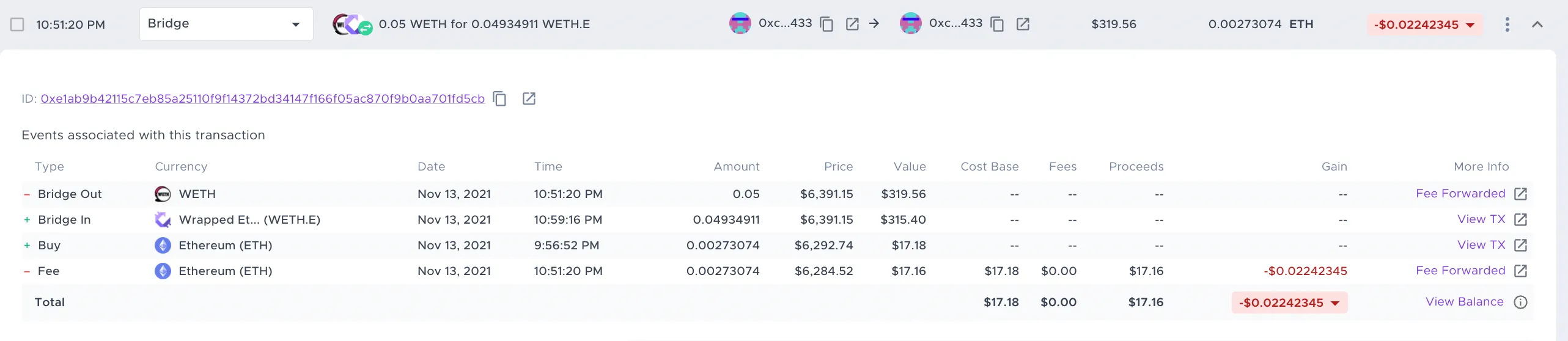
To handle bridging using Summ, follow these simple steps:

  1. Find the transactions related to the bridging event under ‘Review Transactions’. Usually they will be split into an ‘outgoing’ component (sending to the bridge) and an ‘incoming’ component (receiving the asset on the other chain). The example below shows 0.5 WETH being bridged from Ethereum to Avalanche.

bridging-step1.png
  1. Re-categorize the ‘outgoing’ component as ‘Bridge Out’. Do this by clicking on the category box, selecting ‘Advanced’ and then choose the category ‘Bridge Out’ on the right side of the page.

bridging-step2.png
  1. Re-categorize the ‘incoming’ component as ‘Bridge In’ using the same process as step 2.
  2. The two components will then group to form a single line categorized as a ‘Bridge’. The cost basis from the original asset will be moved across to the asset on the destination chain, even if it is a pegged or wrapped version of the original asset.
bridging-step4.png

Important Notes

  • Both the ‘Bridge Out’ and ‘Bridge In’ components must occur within a 24 hour timeframe for them to be grouped together.
  • A ‘Bridge Out’ will match with the next ‘Bridge In’ in chronological order if the following criteria are fulfilled:
    • The two components are within 24 hours
    • The amount that is received is similar to the amount that was sent (5% tolerance accepted)
  • If multiple bridges of the same amount are done in the same 24 hours, ensure that the corresponding ‘Bridge Out’ and ‘Bridge In’ are chronologically one after the other.
  • Bridging transactions will not be auto-categorized, they require manual selection due to the complex nature of the transaction.
  • The cost basis of the original asset on the source chain will be transferred to the asset that is received on the destination chain whether it is the same asset or a pegged/wrapped version.
NFT-Steuerleitfaden
Haben Sie sich im NFT-Handel versucht? In diesem vollständigen Leitfaden werden die Einzelheiten der NFT-Steuern in den USA aufgeschlüsselt, damit Sie sie sicher einreichen können.
US-Steuerleitfaden
Sie sind sich nicht sicher über Ihre Kryptosteuerpflichten? Dieser umfassende Leitfaden hilft Ihnen dabei, Ihre Kryptosteuern in den USA zu verstehen und einzureichen.
DeFi-Steuerleitfaden
Hast du dich mit DeFi beschäftigt? In diesem ausführlichen Leitfaden werden die Einzelheiten der DeFi-Steuern in den USA beschrieben, sodass Sie diese mit Zuversicht einreichen können.
Understanding the different tax reports available
Managing and inviting clients
Ways of working with clients: Full service, collaboration, and self-service
Verwenden verschiedener Inventarmethoden

The information provided on this website is general in nature and is not tax, accounting or legal advice. It has been prepared without taking into account your objectives, financial situation or needs. Before acting on this information, you should consider the appropriateness of the information having regard to your own objectives, financial situation and needs and seek professional advice. Summ (formerly Crypto Tax Calculator) disclaims all and any guarantees, undertakings and warranties, expressed or implied, and is not liable for any loss or damage whatsoever (including human or computer error, negligent or otherwise, or incidental or Consequential Loss or damage) arising out of, or in connection with, any use or reliance on the information or advice in this website. The user must accept sole responsibility associated with the use of the material on this site, irrespective of the purpose for which such use or results are applied. The information in this website is no substitute for specialist advice.

FAQ

No items found.
Table of contents
heading2
heading3

More resources

CryptoTax Calculator thumbnail
Blog
2
 
Apr
 
2026
The Crypto Neobank You Need Isn't What You Think

Most crypto neobanks are custodied fintech in disguise. Here's what a real Bitcoin onchain neobank looks like, and why the difference matters to your tax position.

Read More
CryptoTax Calculator thumbnail
Blog
12
 
Mar
 
2026
Product Update: Kalshi, MegaETH, CoinRabbit, Bittensor, and WhiteBIT support now live

Summ now supports Kalshi, MegaETH, CoinRabbit, and WhiteBIT. Import your prediction market trades, Layer 2 transactions, lending activity, and exchange data for complete tax reporting.

Read More
CryptoTax Calculator thumbnail
Blog
19
 
Jan
 
2026
Buy, Borrow, Die Strategy Explained: A Tax-Efficient Way to Use Capital

The Buy, Borrow, Die approach has long been used in traditional finance to preserve wealth, optimize taxes, and maintain exposure to appreciating assets. With the rise of crypto-backed lending, the same framework has become increasingly relevant for digital asset holders, making it accessible far beyond institutional circles.

Read More

Starten Sie jetzt kostenlos

Importieren Sie Ihre Transaktionen und erstellen Sie eine kostenlose Berichtsvorschau

Blog

24 June 2022

X

 Min read

How is Bridging Crypto Taxed?

Wondering about the tax implications of bridging your crypto assets? We’ve got the answers for you in our blog.

Shane Brunette

Key takeaways

  • If bridging is considered a disposal by tax authorities, then it is a taxable event.
  • Software like Summ (formerly Crypto Tax Calculator) can help you record and calculate the taxes you owe from bridging crypto.

This tax guide is regularly updated: Last Update 

....

April

1

2025

What is bridging?

Just as the name suggests, a blockchain bridge connects two different chains and allows assets to move from one to the other. Bridging is a relatively new transaction type that has been born out of necessity as more blockchains are created and DeFi users wish to move their assets from chain to chain to take advantage of different opportunities.

Bridging often consists of many different transactions and can even result in the change of the underlying asset to a pegged or wrapped derivative (depending on the bridge and source/destination chain). Summ (formerly Crypto Tax Calculator) can handle these complex transactions, allowing you to reconcile any cross-chain transactions and report your tax obligations correctly.

What are the tax implications of bridging?

Right now, there is a lack of specific guidance on the tax implications of bridging crypto assets from the majority of tax regulatory bodies around the world. This has led to two dominant schools of thought on the issue: those who see bridging as a taxable event (conservative), and those who do not (aggressive). Let’s dive in.

In most regions, a capital gains taxable event regarding crypto activity happens when there’s a ‘disposal’ of an owner’s asset. A disposal is defined as a change of ownership in a specific asset; for example, when selling ETH for BTC. The seller is ‘disposing’ of their ETH to receive BTC in return.

The conservative approach:

For those who classify bridging as a taxable event, they view the bridging event itself as a disposal. When transferring a crypto asset cross-chain, they believe that this asset has left the beneficial ownership of it’s original holder when making this journey. The discussion hinges on the argument that moving assets across fundamentally different blockchains might be considered creating materially different assets, accompanied by the argument that by granting the smart contract the ability to make this cross-chain journey, the owner is giving up ownership over their assets.

The aggressive approach:

In the aggressive approach, it is argued that because of the lack of guidelines available from your tax regulatory body, bridging is the equivalent of transferring crypto between two wallets owned by the same user. You would argue that, as a result, this doesn’t constitute a disposal event, and as such, you wouldn’t incur capital gains tax.

We recommend that you work with a local tax professional to decide what approach is best for your personal circumstances.

{{bridging-crypto-tax-cta1}}

How can Summ help?

Handling Bridging in the Platform

To handle bridging using Summ, follow these simple steps:

  1. Find the transactions related to the bridging event under ‘Review Transactions’. Usually they will be split into an ‘outgoing’ component (sending to the bridge) and an ‘incoming’ component (receiving the asset on the other chain). The example below shows 0.5 WETH being bridged from Ethereum to Avalanche.
bridging-step1.png
  1. Re-categorize the ‘outgoing’ component as ‘Bridge Out’. Do this by clicking on the category box, selecting ‘Advanced’ and then choose the category ‘Bridge Out’ on the right side of the page.
bridging-step2.png
  1. Re-categorize the ‘incoming’ component as ‘Bridge In’ using the same process as step 2.
  2. The two components will then group to form a single line categorized as a ‘Bridge’. The cost basis from the original asset will be moved across to the asset on the destination chain, even if it is a pegged or wrapped version of the original asset.
bridging-step4.png

Important Notes

  • Both the ‘Bridge Out’ and ‘Bridge In’ components must occur within a 24 hour timeframe for them to be grouped together.
  • A ‘Bridge Out’ will match with the next ‘Bridge In’ in chronological order if the following criteria are fulfilled:
    • The two components are within 24 hours
    • The amount that is received is similar to the amount that was sent (5% tolerance accepted)
  • If multiple bridges of the same amount are done in the same 24 hours, ensure that the corresponding ‘Bridge Out’ and ‘Bridge In’ are chronologically one after the other.
  • Bridging transactions will not be auto-categorized, they require manual selection due to the complex nature of the transaction.
  • The cost basis of the original asset on the source chain will be transferred to the asset that is received on the destination chain whether it is the same asset or a pegged/wrapped version.

Discover savings opportunities and lower your tax with Summ

Get started for free

Keine Kreditkarte benötigt

Track all your swaps, trades and DeFi activity with Summ for easy tax reporting

Get started for free

Keine Kreditkarte benötigt

Struggling with your tax?

Let Summ do the hard work for you.

Select country

Connect accounts

Get tax report

Get started for free

Keine Kreditkarte benötigt

Automate your record keeping with Summ

Get started for free

Keine Kreditkarte benötigt

Get started for free

Keine Kreditkarte benötigt

Häufig gestellte Fragen

Wie wird die Kryptosteuer berechnet?

Abhängig von der Art der Kryptowährungstransaktion und Ihren individuellen Umständen können Sie sowohl für Kapitalerträge als auch für die Einkommenssteuer haften. Beispielsweise müssen Sie möglicherweise Kapitalgewinne aus Gewinnen aus dem Kauf und Verkauf von Kryptowährungen zahlen oder Einkommenssteuer auf Zinsen zahlen, die Sie beim Halten von Krypto verdienen.

Ich habe Geld beim Handel mit Kryptowährungen verloren. Zahle ich immer noch Steuern?

Die Art und Weise, wie Kryptowährungen in den meisten Ländern besteuert werden, bedeutet, dass Anleger unter Umständen trotzdem Steuern zahlen müssen – unabhängig davon, ob sie insgesamt einen Gewinn oder Verlust erzielt haben. Abhängig von den jeweiligen Umständen werden Steuern in der Regel zum Zeitpunkt der Transaktion fällig und nicht auf Basis der Gesamtposition am Ende des Finanzjahres.

How do I calculate tax on crypto-to-crypto transactions?

In most countries you are required to record the value of the cryptocurrency in your local currency at the time of the transaction. This can be extremely time consuming to do by hand, since most exchange records do not have a reference price point, and records between exchanges are not easily compatible.

How can Summ help with crypto taxes?

You just need to import your transaction history and Summ (formerly Crypto Tax Calculator) will help you categorize your transactions and calculate realized profit and income. You can then generate the appropriate reports to send to your accountant and keep detailed records handy for audit purposes.

Wie berechne ich die Steuer auf Krypto-zu-Krypto-Transaktionen?

In den meisten Ländern sind Sie verpflichtet, den Wert der Kryptowährung zum Zeitpunkt der Transaktion in Ihrer Landeswährung zu erfassen. Dies kann äußerst zeitaufwendig sein, wenn Sie es manuell machen, da die meisten Börsenaufzeichnungen keinen Referenzpreis enthalten und Aufzeichnungen zwischen verschiedenen Börsen nicht leicht miteinander kompatibel sind.

Wie kann Summ bei Kryptosteuern helfen?

Sie müssen nur Ihren Transaktionsverlauf importieren, und Summ (früher Crypto Tax Calculator) hilft Ihnen dabei, Ihre Transaktionen zu kategorisieren und den realisierten Gewinn sowie das erzielte Einkommen zu berechnen. Anschließend können Sie die entsprechenden Berichte erstellen, um sie an Ihren Buchhalter zu senden, und detaillierte Aufzeichnungen für Prüfungszwecke griffbereit haben.

Kann ich nicht einfach meinen Buchhalter dazu bringen, das für mich zu erledigen?

Wir empfehlen Ihnen immer, mit Ihrem Buchhalter zusammenzuarbeiten, um Ihre Unterlagen zu überprüfen. Wenn Sie möchten, dass Ihr Buchhalter Ihnen bei der Abstimmung von Transaktionen hilft, können Sie ihn zu Summ (früher Crypto Tax Calculator) einladen und direkt in der Web-App zusammenarbeiten. Außerdem bieten wir eine vollständige Buchhalter-Suite, die speziell auf Steuerberater und Buchhalter zugeschnitten ist.

Behandelt Summ Aktivitäten, die nichts mit Börsen zu tun haben?

Summ wickelt alle Aktivitäten ab, die nichts mit der Börse zu tun haben, z. B. Onchain-Transaktionen wie Airdrops, Staking, Mining, ICOs und andere DeFi-Aktivitäten. Egal, welche Aktivitäten Sie im Bereich Krypto ausgeführt haben, wir bieten Ihnen unsere benutzerfreundliche Kategorisierungsfunktion, ähnlich wie Expensify.

Muss ich für historische Steuerberichte bezahlen?

Unsere Abonnementpreise verstehen sich pro Jahr, nicht pro Steuerjahr. Mit einem Jahresabonnement können Sie Ihre Kryptosteuern also bereits 2013 berechnen. Der Vorgang ist derselbe. Laden Sie einfach Ihren Transaktionsverlauf aus diesen Jahren hoch und wir kümmern uns um den Rest.

Kann ich meinen eigenen Buchhalter beauftragen?

Ja, Summ wurde entwickelt, um buchhalterfreundliche Steuerberichte zu erstellen. Sie importieren einfach Ihren gesamten Transaktionsverlauf und exportieren Ihren Bericht. Das bedeutet, dass Sie Ihre Bücher selbst auf den neuesten Stand bringen können, wodurch Sie viel Zeit sparen und die von Ihrem Buchhalter berechneten Rechnungen reduzieren können. Sie können Steuerszenarien mit Ihrem Buchhalter besprechen und ihn den Bericht überprüfen lassen.

Wie funktioniert die Bezahlung?

Summ bietet ein Jahresabonnement an, das alle vorherigen Steuerjahre abdeckt. Wenn Sie Ihre Steuererklärung für frühere Jahre ändern müssen, ist dies mit einer zusätzlichen Zahlung verbunden.

Was ist, wenn meine Börse nicht auf der Liste der unterstützten Börsen steht?

Summ deckt Tausende von Börsen, Wallets und Blockchains sowie DeFi-Apps ab. Wenn Sie Ihre Börse jedoch nicht auf der unterstützten Liste sehen, arbeiten wir gerne mit Ihnen zusammen, um sie zu unterstützen. Wenden Sie sich einfach an [email protected] oder über die In-App-Chat-Support-Funktion und wir kümmern uns darum.

Unterstützt Summ NFT-Transaktionen?

Das tun wir! Summ lässt sich in viele NFT-Marktplätze integrieren und bietet Kategorisierungsoptionen für alle NFT-bezogenen Aktivitäten (Prägen, Kaufen, Verkaufen, Handeln).

Wie funktioniert die kostenlose Testversion?

Summ (früher Crypto Tax Calculator) kann sofort nach der Anmeldung kostenlos verwendet werden, sodass Sie Ihre Transaktionen importieren und unsere intelligente Engine für Vorschläge und automatische Kategorisierung, Portfolio-Tracking sowie DeFi- und NFT-Support nutzen können. Um auf Berichte, das Tax Loss Harvest Tool oder Chat- und Priority-Support zugreifen zu können, müssen Sie auf den entsprechenden kostenpflichtigen Tarif upgraden.

Automatisieren Sie Ihre Krypto-Buchhaltung

01

SOC 2 Typ 2-zertifiziert

Da wir SOC 2 Typ 2-konform sind, gewährleisten wir eine robuste Datensicherheit und geben Kunden das Vertrauen, uns zu vertrauen.
02

Sichere Organisation

Wir führen regelmäßige und gründliche Security & Awareness-Schulungen für alle Mitarbeiter durch.
03

Vollständiger Datenschutz

Unsere Anwendung erfordert immer nur Lesezugriff auf Ihre Daten.