How to pay tax on crypto in the UK
Use our step-by-step guide to calculate your crypto taxes for free with the use of helpful tables, examples and key information from the HMRC.
Key takeaways
- Download your crypto transaction history from all exchanges and wallets you have used.
- Categorise transactions that are subject to Capital Gains Tax or Income Tax and apply relevant HMRC rules.
- Deduct eligible fees and offset losses to reduce taxable gains and save on taxes.
- Use software like Summ (formerly Crypto Tax Calculator) to automate the process for you, help reduce errors, and make tax time stress free.
In the UK, His Majesty's Revenue and Customs (HMRC) treats crypto transactions as taxable events, meaning you may owe taxes on your capital gains or income derived from crypto.
This includes crypto-to-crypto transactions, the use of stablecoins, DeFi protocols, and income derived from on-chain activities like yield farming and staking. So if you have been carrying out these types of transactions but not converted your crypto back into fiat currency, you may still be liable for taxes.
This is because the HMRC treats cryptocurrencies as property, rather than currency.
This article provides a detailed step-by-step guide of how to calculate your cryptocurrency taxes in the UK and report them to the HMRC at for each financial year starting on 6 April and ending on the following 5 April.
From identifying taxable events to calculating your liabilities for both Capital Gains Tax and Income Tax, we’ll break down everything you need to know to stay on top of your obligations.
Save Time With Summ
Simply connect your exchange accounts and wallets to Summ (formerly Crypto Tax Calculator) and our software will calculate your capital gains, income and deductions. Get a crypto tax report ready to submit to HMRC or your accountant.
Step 1. Record keeping
Before you begin calculating your crypto taxes, you need to ensure that you have accurate records of all your transactions in Pounds Sterling (GBP). These can be obtained from centralised exchanges, usually as a CSV spreadsheet.
If you have been trading on international exchanges, you need to value these transactions in GBP consistently, such as by cross-referencing prices with a local exchange.
If you have been trading on decentralised exchanges (DEXs), then you should consider using specialised tax software such as Summ (formerly Crypto Tax Calculator) (formerlySumm) to accurately calculate your transaction data. You may also choose to keep manual records, but be aware that this makes it much harder to ensure accurate records, especially if handling complex DeFi transactions.
In addition to tracking your transactions and assets in GBP, you need to keep a record of the following with each transaction:
- Date and time of the transaction
- Transaction types (e.g., buys, sells, swaps)
- Associated fees (e.g., transaction fees, gas fees, margin fees)
- Amounts and types of cryptocurrency involved
- GBP value of crypto at the time of each transaction
You may also want to record the following information regularly, to make your books easier to review in case of an enquiry.
- Cumulative total of the investment units (ie, crypto) held as a result of the transaction
- Any relevant wallet addresses and bank accounts
- Maintain your records for at least 5 years after the end of the normal submission window for your tax return (i.e. 31 January following the 6 April financial year end)
If you have a lot of trades spread across multiple exchanges and DeFi protocols, then you should consider using crypto tax software like Summwhich automatically analyses all relevant transaction data for you, calculates your tax owed, and summarises it in a professional report ready for the HMRC.
Step 2. Identify taxable events
Before calculating your crypto taxes, you need to understand which activities trigger a taxable event under UK law.
You will then need to identify any taxable events in the transaction records you made in Step 1.
HMRC treats cryptocurrencies as akin to property or shares, and many transactions involving crypto are considered disposals, which may result in Capital Gains Tax (CGT) or Income Tax, depending on the nature of the transaction.
As such, you will need to divide your taxable events into either CGT or Income Tax events.
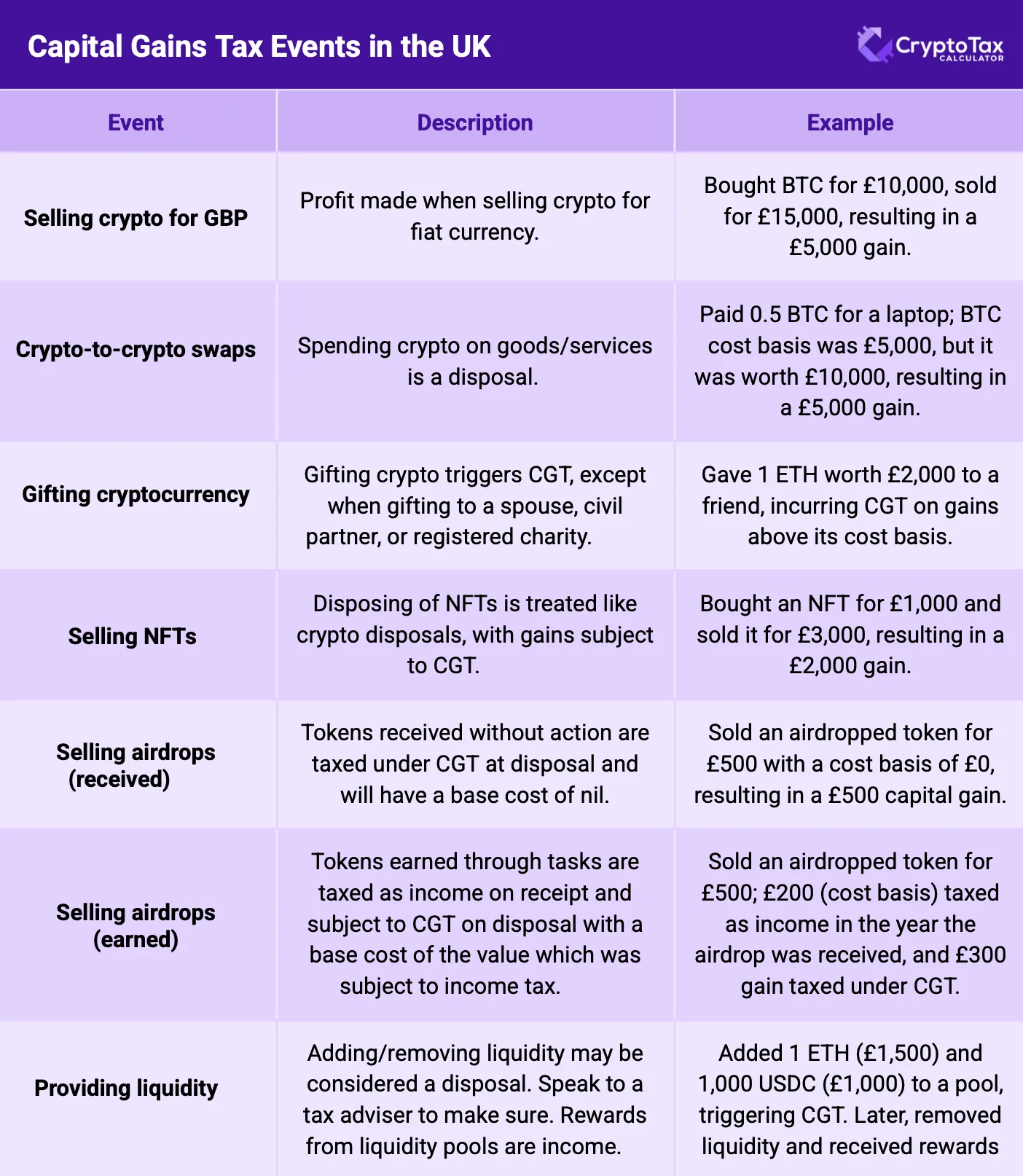
Events subject to Capital Gains Tax
These events occur when you dispose of your cryptocurrency.
"Disposal" includes selling, trading, or gifting crypto assets (except to a spouse or civil partner).
Each event triggers a CGT liability if the transaction results in a gain.
However, recording losses is equally important, as they can offset gains and reduce your overall tax burden.
Events subject to Income Tax
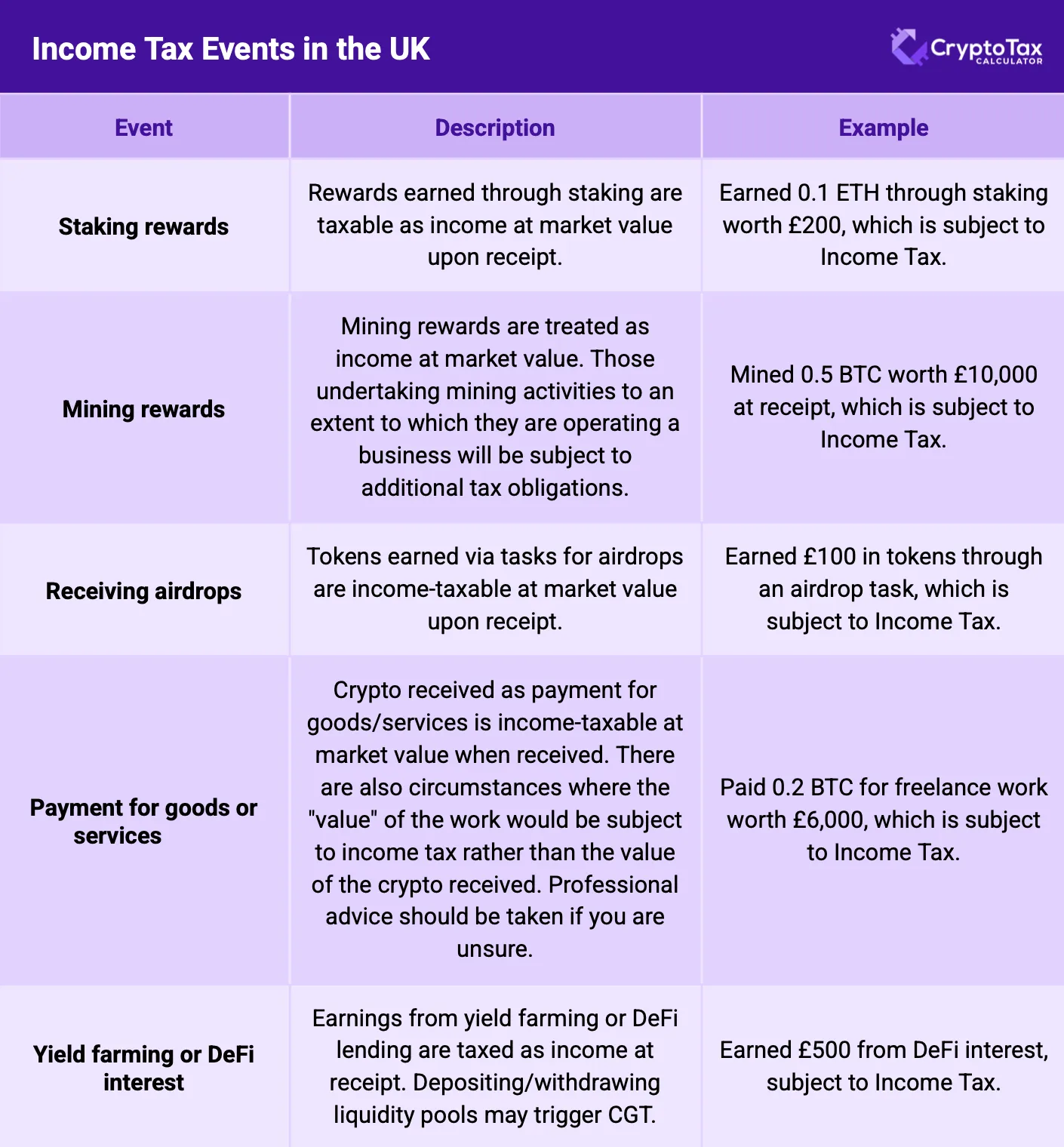
Certain events are classified as income and are subject to Income Tax instead of CGT. These typically involve receiving cryptocurrency as payment or rewards.
Step 3. Apply Special HMRC rules
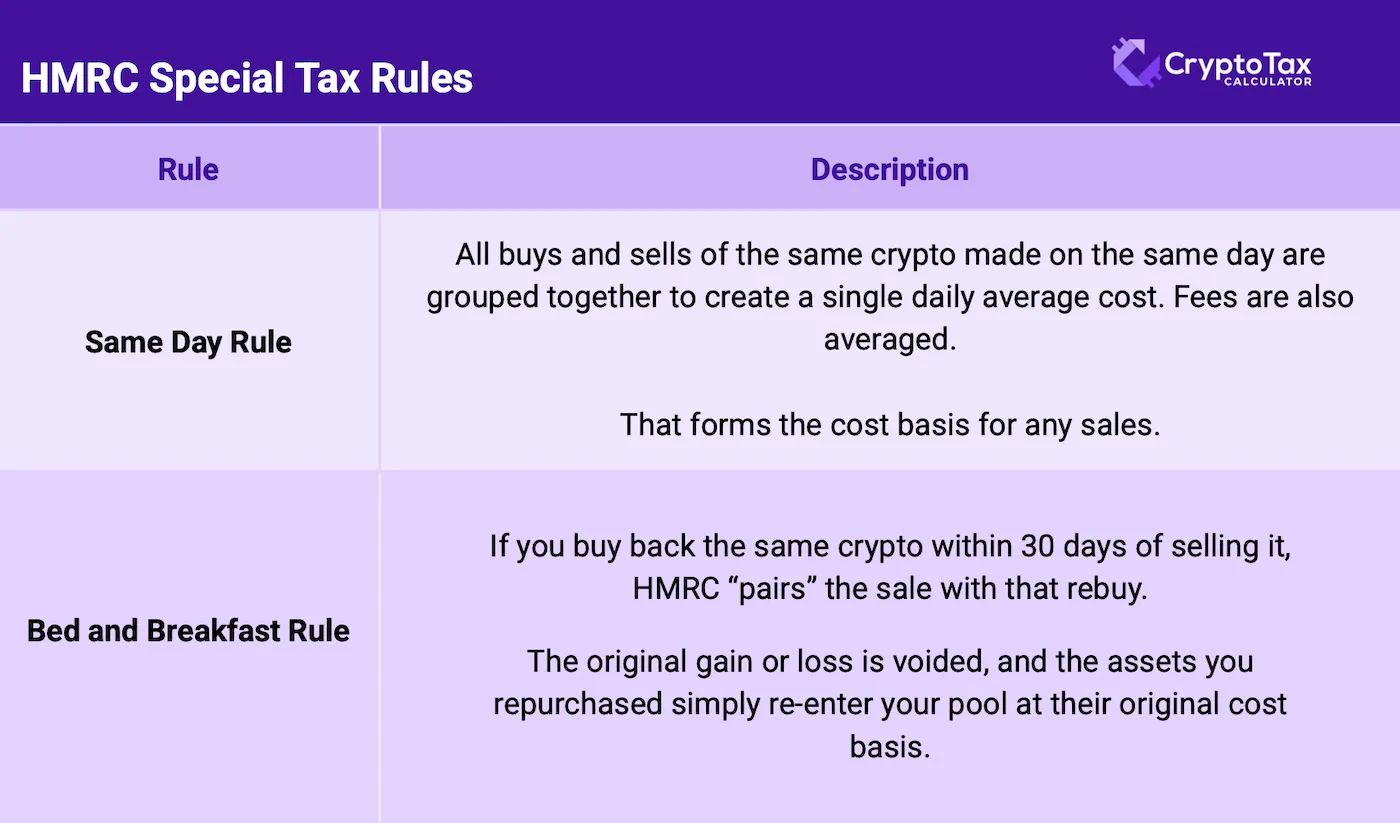
There are special rules that apply to investment assets like cryptocurrencies. These rules may change how much capital gains tax you owe.
You need to apply these rules before calculating your cost basis and subsequent capital gains tax.
HMRC Special Tax Rules
Same Day Rule
Any trades that you make on the same day with the same cryptocurrency are first grouped together before adding the leftover to the average cost basis pool.
| Time | Trade | Price | Quantity | Total Balance | Adjusted Cost Basis | Gain (Loss) | |
|---|---|---|---|---|---|---|---|
| (1) | Jan 2nd 9am | Buy | 500 | 1 | 1 | 500 | - |
| (2) | Jan 4th 9am | Buy | 1000 | 1 | 2 | - | - |
| (3) | Jan 4th 10am | Buy | 3000 | 1 | 3 | - | - |
| (4) | Jan 4th 11am | Sell | 5000 | 1 | 2 | 1,250 | 3,000 |
In this scenario the buy transactions on Jan 4th are grouped with an average cost basis of £2,000 and the sell on the 4th is applied to this daily average cost basis, realising a gain of £3,000.
The remaining 1 BTC with an average cost basis of £2,000 is then added to the pool making a new average pool of £1,250.
The same is also true for fees, meaning any fees paid within the same day will also be grouped together.
| Time | Trade | Price | Quantity | Fee % | Fee | |
|---|---|---|---|---|---|---|
| (1) | Jan 5th 9am | Sell | 2000 | 1 | 10% | 200 |
| (2) | Jan 5th 10am | Sell | 2000 | 1 | 20% | 400 |
In this scenario, the two sell transactions both occur on the 5th of January, and each have a different fee rate.
Due to the Same Day rule, the fees for these two transactions are grouped, resulting in an average fee rate of 15%.
Within Summ, the value of the fee shown in the transaction breakdown table will be based on this calculated average fee for all transactions within the same day, rather than the rate for the individual transaction.
That is, each transaction will show a 15% fee rate, with the value of the fee being £300 for each, rather than £200 for the first transaction and £400 for the second.
Bed and Breakfast Rule
To avoid people taking advantage of the average cost basis, and tax free threshold, the government introduced the bed and breakfast rule, named after a tax loss harvesting strategy where investors would sell their stock on the last day of the financial year and buy it back the next day.
This rule essentially states that if you buy back the cryptocurrency within 30-days of its disposal, regardless of the tax year, you will “void” the capital gains event previously associated with this transaction, and instead rematch the buy and the sell.
Example: Buying back within 30 days
Violation of Bed and Breakfast rule
| Date | Trade | Price | Quantity | Gain (Loss) | |
|---|---|---|---|---|---|
| (1) | 1st January | Buy | 10,000 | 1 | - |
| (2) | 3rd April | Sell | 13,000 | 1 | 3,000 |
| (3) | 8th April | Buy | 14,000 | 1 | - |
You buy 1 BTC with an average cost of £10,000.
You then sell the BTC aiming to realise a gain of £3,000 in this tax year to use up the new £3,000 tax-free allowance. You then re-buy the BTC in the next financial year, with the new average cost basis being £14,000 per BTC.
However, the rules per the example below would apply and the gain is effectively “nullified”.
Apply Bed and Breakfast rule
| Date | Trade | Price | Quantity | Gain (Loss) | |
|---|---|---|---|---|---|
| (1) | 1st January | Buy | 10,000 | 1 | - |
| (2) | 3rd April | Sell | 13,000 | 1 | (1,000) |
| (3) | 8th April | Buy | 14,000 | 1 | - |
The correct application of the BnB rule matches the re-buy with the sells in the last 30 days. In this case we adjust our gain to a loss of £1,000.
Additionally, the average cost basis continues to be £10,000 per BTC.
Step 4. Calculate your Average Cost Basis
If the special cost basis rules do not apply, then you need to use the average cost basis, also known as a section 104 pool, to calculate the cost on capital gains.
For example, if you buy 1 BTC at £1,000 and a second BTC for £3,000, your average cost would be £2,000.
| Date | Trade | Price | Quantity | Total Balance | Average Cost Basis | Gain (Loss) | |
|---|---|---|---|---|---|---|---|
| (a) | 1st January | Buy | 1,000 | 2 | 2 | 1,000 | - |
| (b) | 3rd January | Buy | 3,000 | 2 | 4 | 2,000 | - |
| (c) | 6th February | Sell | 4,000 | 1 | 3 | 2,000 | 2,000 |
In the above example, you can see how the Average Cost Basis increases from (a) to (b), and a capital gain is realised against this average cost at time (c).
Step 5. Deduct fees
Deduct transaction fees (in GBP) from your gains to reduce your taxable amount.
HMRC's rules specify that only costs that are "wholly and exclusively" incurred as part of acquiring, disposing or enhancing the value of the asset can be deducted from your gains.
Fees must be directly incurred for the purpose of acquiring, disposing of, or enhancing the value of the asset. With that in mind, let's look at which fees are likely to be eligble.
Fees likely to be eligble as deductions
- Transaction fees: These are fees charged by exchanges or platforms for executing trades.
- Gas fees (transactions): If the gas fee is part of a taxable event (e.g., swapping crypto on a DEX), it can be included in the cost basis or deducted from the proceeds.
Fees likely to be ineligble as deductions
The following fees are highly unlikely to be deductible from your tax as they are not directly connected to acquisition or disposal, unless you can demonstrate they were "wholly and exclusively" incurred as part of acquiring, disposing or enhancing the value of the asset:
- Deposit and Withdrawal Fees: Costs incurred when transferring fiat or crypto into or out of an exchange. These fees are typically not deductible for CGT purposes, as they are not directly related to the disposal (ie, sale) of crypto.
- Gas fees (transfers): Gas fees for transferring crypto to a wallet for the purpose of storage.
How to deduct fees from capital gains
- For Sales or Disposals: Deduct transaction fees from the proceeds to calculate your net gain or loss.
Example: You sell ETH for £5,000, incurring a £100 transaction fee. Your taxable proceeds are £4,900.
- For Acquisitions: Add transaction fees to the purchase price to adjust your cost basis.
Example: You buy BTC for £10,000 and pay a £50 fee. Your cost basis becomes £10,050.
Why you should keep track of your fees
- Reduces taxable gains: Deducting allowable fees lowers the taxable amount, potentially saving you money on your tax bill.
- Ensures compliance: HMRC expects detailed records of all fees related to taxable events.
Step 6. Calculate your capital gains or losses
Now that you have determined your average cost-basis and appropriately grouped your transactions – including any special rules – you are ready to calculate the capital gains or losses for each taxable event.
What are capital gains and losses?
- Capital losses: A capital loss occurs when the sale or disposal of cryptocurrency results in less than its cost basis. Capital losses can be used to offset capital gains in the period in which they are made or they can be carried forwards to use against future capital gains, reducing your overall capital gains tax liability.
- Capital gains: A capital gain occurs when you sell, trade, or dispose of cryptocurrency for more than its cost basis.
How to calculate capital gains and losses
- Identify the sale price: Determine the value in GBP of the cryptocurrency when it was sold or disposed of. Use the market price at the time of the transaction.
- Subtract the average cost basis: Subtract the calculated cost basis (from Step 4) from the sale price to find the gain or loss.
- Account for fees: Deduct any associated transaction fees from the sale price. Ensure these fees meet the"wholly and exclusively" criteria to qualify as deductible. You should have calculated these in Step 5.
Example: Calculating a capital gain
| Transaction details | Amount (£) |
|---|---|
| Sale price | 30,000 |
| Cost basis | 20,000 |
| Trading fee | 500 |
| Capital gain | 9,500 (30,000 - 20,000 - 500) |
Example: Calculating a capital loss
| Transaction details | Amount (£) |
|---|---|
| Sale price per ETH | 900 |
| Cost basis per ETH | 1,200 |
| Capital loss per ETH | 300 loss (900 - 1,200) |
How to use losses to offset gains
Losses can be deducted from gains to reduce your overall taxable amount.
- Example: If you have £10,000 in gains and £4,000 in losses, your taxable gain is reduced to £6,000.
If your capital losses exceed your gains in a tax year, the excess losses can be carried forward to offset capital gains in future tax years and reduce your tax. To utilise this benefit, you must first report the losses to HMRC in your Self Assessment tax return.
Get started with Summ
Step 7: Calculate income from cryptocurrency activities
When you earn cryptocurrency through activities like mining, staking, or receiving payments, these earnings are subject to Income Tax. You identified these activities in Step 2.
Calculating the taxable income requires determining the market value of the cryptocurrency at the time it is received.
If you have already calculated the market value of your various crypto income-earning activities (e.g., staking, airdrops, and yield farming), you can now add them together to determine your overall crypto income.
Otherwise, following the steps below to calculate your income from crypto:
- Record the transaction date: Note the exact date you received the cryptocurrency.
- Determine the market value: Find the value of the cryptocurrency in GBP on the day of receipt using a reliable exchange rate. Where tokens are not widely traded, it may be more difficult to obtain this data so records must be kept to support the value reported on your tax return.
- Calculate the taxable income: Multiply the amount of cryptocurrency received by its GBP value.
- Include in your total income: Add the calculated amount to your overall taxable income for the year.
Example: Mining income
You mine 0.5 BTC on January 15th. The market value of 1 BTC on that date is £20,000.
- Income: 0.5 BTC × £20,000 = £10,000 taxable income.
Include this £10,000 in your Self Assessment tax return under income.
Step 8: Calculate your overall crypto tax liability
Once you've calculated your crypto-related capital gains, losses, and income, the next step is to determine your total tax liability (ie, the actual amount of tax you owe based on your crypto activity).
This involves integrating these figures with your other taxable income and capital gains for the year.
Here's how to do it:
1. Combine crypto capital gains with other capital gains
HMRC requires you to report all capital gains for the tax year, not just those from crypto. This includes gains from things like selling stocks and shares.
- Add your crypto capital gains to gains from these other sources.
- Deduct your annual CGT allowance from the total.
- For 2024-2025 and 2025-26, it will be £3,000.
- Only the amount exceeding the allowance is subject to Capital Gains Tax (CGT).
Example:
| Source | Capital Gain (£) |
|---|---|
| Stocks | 5,000 |
| Crypto (BTC sale) | 10,000 |
| Total Gains | 15,000 |
| CGT Allowance | 3,000 |
| Taxable Gain | 12,000 |
2. Calculate capital gains tax
Use the following rates for gains above the allowance:
- 18% for basic rate taxpayers.
- 24% for higher or additional rate taxpayers.
Your rate depends on your total taxable income, including crypto income and other sources.
| Taxpayer Type | Taxable Gain (£) | CGT Rate | CGT (£) |
|---|---|---|---|
| Basic Rate Taxpayer | 9,000 | 10% | 900 |
| Higher Rate Taxpayer | 9,000 | 20% | 1,800 |
3. Add crypto income to other taxable income
Combine your crypto income (e.g., staking, mining, payments) with your salary, self-employment income, or other earnings.
Apply the standard Income Tax rates to your total taxable income:
| Income Band (£) | Tax Rate (%) | Description |
|---|---|---|
| Up to £12,570 | 0% | Personal Allowance |
| £12,571 to £50,270 | 20% | Basic Rate |
| £50,271 to £125,140 | 40% | Higher Rate |
| Above £125,140 | 45% | Additional Rate |
Note: For those earning above £100,000 the Personal Allowance is reduced by £1 for every £2 of earnings over £100,000. This is known as “tapering” and can lead to a very high effective tax rate.
Example:
| Income Source | Income (£) |
|---|---|
| Salary | 40,000 |
| Crypto Staking Rewards | 10,000 |
| Total Taxable Income | 50,000 |
4. Adjust for allowable losses
Deduct allowable capital losses from your total capital gains to reduce your CGT liability.
If losses exceed gains, carry the excess forward to future tax years to offset gains.
Example:
| Component | Amount (£) |
|---|---|
| Total Gains | 15,000 |
| Total Losses | (5,000) |
| Adjusted Gains | 10,000 |
5. Calculate your total tax liability
Add together:
- Capital Gains Tax (from Step 2 of this section).
- Income Tax (from Step 3 of this section).
Example:
| Tax Component | Amount (£) |
|---|---|
| Capital Gains Tax | 1,800 |
| Income Tax (Crypto Income) | 2,000 |
| Total Tax Liability | 3,800 |
6. File your taxes
Report all calculations and figures in your Self Assessment tax return.
Ensure crypto income and gains are listed in the designated sections.
It is generally recommended that the “white space” on the tax return is used to provide further details to HMRC of any assumptions made within the calculations.
Get started with Summ
How DeFi is Taxed in the UK
Decentralised Finance (DeFi) transactions are taxed in the UK based on their nature and the specific activity conducted.
HMRC has not issued extensive DeFi-specific guidance, but applies general cryptocurrency and financial asset tax principles to these transactions.
Here’s an overview of how common DeFi activities are taxed:
Airdrops
The HMRC only considers airdrops as income tax if you did something to “earn” the reward.
An example of this would be answering a survey and receiving tokens in return or receiving a specific token in exchange for trading on a particular platform, such as receiving UNI for trading on Uniswap.
When you sell the airdrop, the cost basis is the market value at the time of receiving the airdrop reward if you have paid income tax on it. If you have received the airdrop without performing an action in return for it, income tax will not be due but the base cost will be nil.
You should talk to your accountant about your individual circumstances.
Using Summ, you can classify transactions as an airdrop if it is not considered income, otherwise you can classify the trade as income.
Staking
The HMRC has stated that staking rewards are taxed as income. Summ will separate out staking rewards as income earned.
Once you have earned income from staking, the initial value forms the cost basis for your capital gains or loss. In this way you are not “double taxed”.
For example if you receive £10 of ETH for staking, and later sell the ETH for £100, your income is £10 and your capital gain is £90.
How crypto mining is taxed in the UK
Mining has different tax implications depending on whether you are a hobby or business miner.
For hobby mining Summ will calculate your initial cost basis as the market value when receiving the reward.
This market value is also treated as income by the HMRC. As with airdrops, if the mined token has a market value which is nil, no income tax is due but the base cost when you dispose of the token will be nil.
How hard forks are taxed in the UK
Forking essentially creates a new cryptocurrency that will go into its own holding pool.
The cost basis of the forked cryptocurrency is calculated based on the crypto assets already held by the individual.
How selling NFTs is taxed in the UK
The sale of non-fungible tokens (NFTs) is considered a disposal, similar to selling other cryptoassets.
The market value of the NFT in GBP at the time of sale is used to calculate the gain.
Tax forms you may need for crypto
Cryptocurrency investors in the UK need to include specific forms when filing their tax returns to HMRC.
- SA100 (Self Assessment Tax Return): This is the primary form used for reporting income and capital gains. Include a summary of your total crypto gains or losses in the appropriate section.
- SA108 (Capital Gains Summary): This supplementary form is for reporting detailed information about disposals of assets, including cryptocurrency. You must list each transaction, including date, sale proceeds, and allowable costs.
- Employment Supplementary Pages: If you received crypto as income (e.g., from mining or staking), you’ll need to report it as employment income on the relevant supplementary pages.
Sources
- Check if you need to pay tax when you sell cryptoassets, HM Revenue & Customs, Published 19 December 2018
- Cryptoassets Manual, HM Revenue & Customs, Published 30 March 2021
- Cryptoassets, HM Revenue & Customs, Published 19 December 2018
- Pay tax on cryptoassets, HM Revenue & Customs, Published 29 November 2023
- Check if you need to pay tax when you receive cryptoassets, HM Revenue & Customs, Published 19 December 2018
- Cryptoassets for individuals: which taxes apply, HM Revenue & Customs, Published 30 March 2021
- Tax return reminder for cryptoasset users, HM Revenue & Customs, Published 14 December 2023
- Cryptoassets for businesses: which taxes apply, HM Revenue & Customs, Published 30 March 2021
- Cryptoassets Manual - Staking and DeFi, HM Revenue & Customs, Published March 2021
- Cryptoassets Manual - Airdrops, HM Revenue & Customs, Published March 2021
The information provided on this website is general in nature and is not tax, accounting or legal advice. It has been prepared without taking into account your objectives, financial situation or needs. Before acting on this information, you should consider the appropriateness of the information having regard to your own objectives, financial situation and needs and seek professional advice. Summ (formerly Crypto Tax Calculator) disclaims all and any guarantees, undertakings and warranties, expressed or implied, and is not liable for any loss or damage whatsoever (including human or computer error, negligent or otherwise, or incidental or Consequential Loss or damage) arising out of, or in connection with, any use or reliance on the information or advice in this website. The user must accept sole responsibility associated with the use of the material on this site, irrespective of the purpose for which such use or results are applied. The information in this website is no substitute for specialist advice.
FAQ
For the 2023-2024 tax year, the CGT allowance is £6,000. It will reduce to £3,000 in 2024-2025.
Use the SA100 and SA108 forms to declare your crypto gains. Provide detailed information, including sale proceeds and cost basis.
Yes. Capital gains tax applies to disposals, and income tax applies to crypto received as earnings.
HMRC collects data from crypto exchanges and uses blockchain analytics to monitor transactions.
Yes. Staking rewards are treated as taxable income at the time of receipt.
Forgetting to report crypto taxes can lead to penalties, depending on the reasons for the error: - Careless errors: Penalty up to 30%. - Deliberate errors: Penalty up to 70%. - Concealment: Penalty up to 100%. If you realise you’ve made an error, you can amend your return within 12 months of the original filing deadline. Consider using the HMRC’s Voluntary Disclosure Program to rectify significant errors.

James Edwards has been active in the cryptocurrency industry for over 10 years. He is an avid user of DeFi and believes in the promise of a user-owned and operated web. His expertise as a cryptocurrency journalist has seen him contribute to publications such as Nasdaq, CoinMarketCap and CoinTelegraph.
More resources
How to report your crypto taxes to the HMRC
Wondering how to report your crypto taxes to the HMRC? We’ve got the answers for you in our blog.
Read More
Can the HMRC Track Crypto Transactions?
In the UK, there's a lingering belief among some crypto enthusiasts that their transactions exist in a sort of no-man's…
Read More
How to do your MetaMask taxes in 2025
A step-by-step walkthrough of everything you need to know about calculating your MetaMask crypto tax.
Read More
How To Report Your Coinbase Taxes in the USA
The easiest way to calculate your Coinbase taxes is to use a crypto tax software like Summ, an official Coinbase tax partner.
Read More