

































































































































































































































All Countries

Thank you! Your submission has been received!
Oops! Something went wrong while submitting the form.
Selecting Country
No items found.
2024-08-30

How Investing vs Trading impacts tax

In most cases of buying and selling cryptocurrency as a retail investor, you are participating in investing rather than trading. The two are treated differently for tax purposes.

  • Investing is subject to capital gains tax or income tax, depending on the nature of the transaction.
  • Trading in this case refers to self-employment which is subject to income tax and National Insurance Contributions.

The key difference between investing and trading – along with the different tax treatments, is how losses generated in the crypto-activity can be used.

In their guidance, HMRC have explicitly stated that they would expect it to be exceedingly rare that any crypto-activity constituting buying & selling crypto would be classified as “trading”.

If you are uncertain, speak to a tax advisor as there are always exceptions, including but not limited to, developing tokens and large scale mining.

How is crypto tax calculated in the United States?

You can be liable for both capital gains and income tax depending on the type of cryptocurrency transaction, and your individual circumstances. For example, you might need to pay capital gains on profits from buying and selling cryptocurrency, or pay income tax on interest earned when holding crypto.

CoinLedger

CoinLedger is an accessible crypto tax platform with over 1,000 exchange and wallet integrations.

Best for: Users who want a simple, straightforward experience without complex DeFi needs.

Key differentiator: Offers an unlimited transaction plan for high-volume traders at a fixed price.

Pricing: $49 (100 transactions) to $499+ (10,000+ transactions).

Limitation: Does not generate Schedule D forms - you will need to complete this manually or with other software.

Notable: Strong NFT support with OpenSea integration.

CoinTracker

CoinTracker is a portfolio tracker and tax calculator supporting over 30,000 cryptocurrencies.

Best for: Users who prioritize portfolio tracking alongside tax reporting.

Key differentiator: Direct integrations with TurboTax and H&R Block Desktop.

Pricing: $59 (100 transactions) to $599 (10,000 transactions), with full-service options up to $3,499.

Limitation: Customer support is limited on lower-tier plans - priority support requires the $599 Ultra plan.

Notable: Good security with end-to-end encryption and SOC 2 compliance.

ZenLedger

ZenLedger offers both DIY crypto tax reports and professional full-service accounting.

Best for: Users who want tax loss harvesting included at every pricing tier.

Key differentiator: Tax loss harvesting is available on all plans, not just premium tiers.

Pricing: $49 (100 transactions) to $399 (15,000 transactions).

Limitation: Only offers 400+ exchange integrations - significantly fewer than competitors. Some users report customer support issues with long wait times.

Notable: TurboTax integration and 14-day refund policy.

blog
Aug 30
,
 
2024
 - 
10
min read

How to Report Crypto Taxes with ATO myTax 2024

A complete step-by-step guide to filing your crypto taxes with the ATO through myTax using Crypto Tax Calculator's ATO myTax report.

No items found.
Key takeaways
  • Crypto is classified and taxed as property by the ATO. Capital gains tax (CGT) applies when you sell crypto for a profit, and income tax applies to crypto earned via rewards like staking.
  • You need to collect all of your crypto transaction data for the financial year and calculate any income earned and your capital gains/losses.
  • You report your crypto activity in your annual tax return using the ATO’s myTax portal (or through a registered tax agent).
This tax guide is regularly updated: Last Update  

Given the popularity of myTax in Australia as the ATO’s official online platform for tax reporting, it’s important to understand how to report your crypto profits, losses, and income alongside your regular income and capital gains.

To accurately report your crypto transactions on myTax, you will need to calculate and enter both your crypto capital gains and losses, and any crypto income (like staking rewards or airdrops).

Crypto Tax Calculator can help you track your gains and losses, calculate your capital gains, and get ATO-ready reports in minutes.

Get started with a quick overview of how to report your crypto tax in myTax, or keep reading for detailed step-by-step instructions with screenshots from the ATO’s myTax portal.

{{how-to-report-crypto-on-your-taxes-in-9-steps}}
{{save-yourself-hours-of-calculations}}

Step 1: Gather your documents and data

Accurate crypto tax reporting in Australia starts with thorough recordkeeping, as required by the ATO. Before lodging your tax return through myTax, you’ll need to collect a full summary of your crypto transactions for the financial year. This includes any:

The easiest way to do this is to use tax software like Crypto Tax Calculator which will automatically analyse your transaction history once you connect your exchange accounts or wallets.

Alternatively, most exchanges will let you download a CSV or excel file with your transaction history and relevant information, which can be used to manually calculate your taxes. If you're unable to get this information from your exchange or wallet, then you may need to keep your own records.

For each crypto transaction, the ATO expects you to have the following information to report it on your taxes:

  • A description of the crypto asset
  • The date you acquired and sold the asset and supporting receipts
  • The value in AUD at the time of the transaction
  • The cost base (including purchase price, transaction fees, and other relevant costs)
  • The resulting capital gain or loss
  • Records of any accounting or legal fees you’ve paid or tax software you’ve used
  • Digital wallet records and keys

You can wait until you're preparing to file your tax return to gather these documents and transaction data. However, keeping records throughout the year will likely be easier (and more accurate) so they're ready to go when tax season rolls around.

{{get-started-free-with-trustpilot}}

Step 2: Set up myTax to prepare and personalise your return

To lodge your tax return with myTax, you’ll need to set it up first. Start by creating a myGov account – or using your existing one – to connect to the ATO. From your linked services you will then select ‘Manage tax returns’ to report your tax. You will then need to calculate and report CGT, income, and deductions. If you’re in the middle of filling out the forms but need more time to calculate, you can save what you’ve done so far and come back to myTax at any point.

Here’s how you can prepare your crypto taxes in myTax:

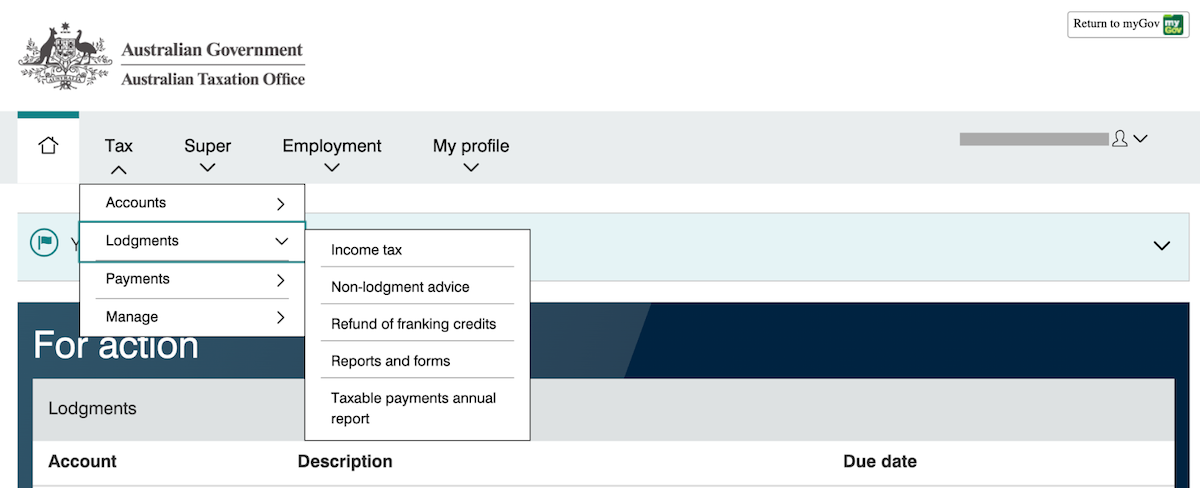
  1. Sign into your myGov account and make sure you’ve linked your account to the ATO to access myTax. Then select Tax → Lodgements → Income tax
mytaxss1
  1. Click ‘Prepare’ for your 2024-2025 Individual income tax return.
mytaxss2
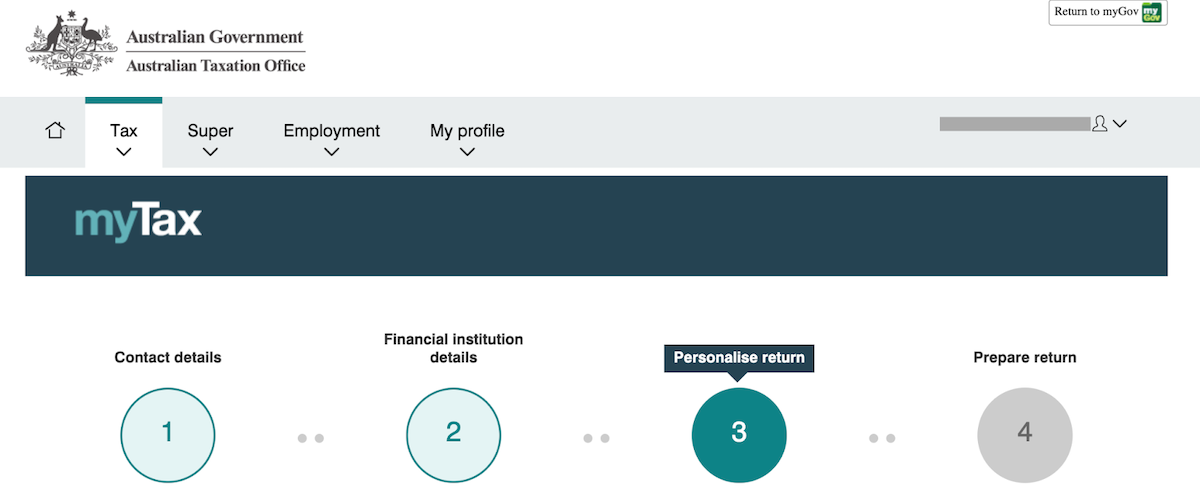
  1. Make sure your contact and banking details are up-to-date. Then select ‘Personalise return.’
mytaxss3
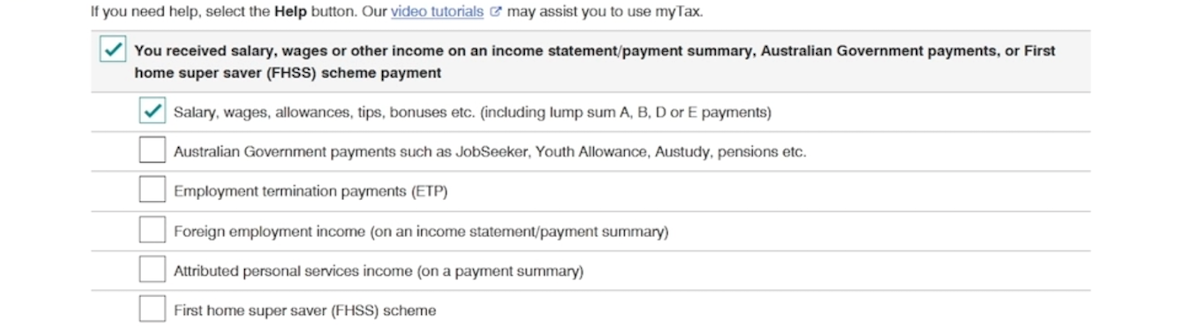
  1. Fill out the relevant boxes for your regular income. Note: some of the boxes may already be selected, if the ATO has received information from your employer, bank, crypto exchange, or another organisation. Most of your pre-fill tax information will be available by late July.

Step 3: Calculate your capital gains and losses

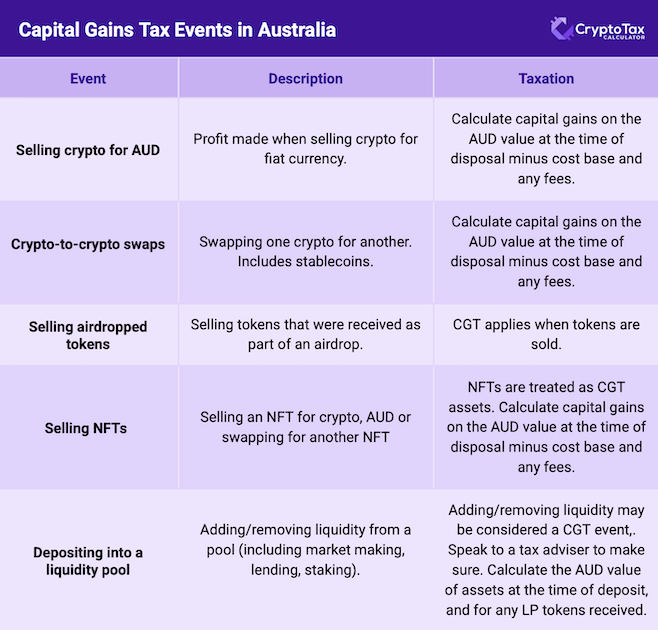
Whenever you dispose of crypto at a profit or loss, a capital gains event is triggered. To figure out how much tax you might owe, you need to calculate your capital gains and losses for each transaction. You’ll need to:

  1. Identify each individual capital gains tax (CGT) event. If you’ve conducted hundreds, or thousands of transactions, a crypto tax calculator like Crypto Tax Calculator can help you automatically identify your overall capital gains and losses.
CGTeventsAustralia 658x630

{{difference-between-capital-gains-tax-income-tax-events}}

  1. Figure out the cost base of your crypto. Your cost base is what you paid for the crypto in AUD, plus any additional fees such as gas, transfer, or brokerage fees.

Figuring out the cost base can be more complicated when you have multiple transactions of the same token at different times and prices. When this happens, the order in which you calculate disposals can impact your tax owed. The two common methods for determining order are:

  • FIFO (First In, First Out): You sell your earliest purchase first
  • LIFO (Last In, First Out): You sell your most recent purchase first

{{50-cgt-discount}}
The accounting method you choose can impact both the cost base and if you qualify for the 50% CGT discount – since it only applies to assets held for more than a year. Since FIFO takes into account your earliest purchases first, it could increase the chance of you receiving the 50% CGT discounts if you’ve held those assets long term.

Still confused? Crypto Tax Calculator can automatically figure out your cost basis for you based on ATO rules. You can also choose the accounting method that works best for your situation. If you have a lot of transactions or get stuck figuring out your cost base, Crypto Tax Calculator can help automate the tricky calculations to make this process a lot easier.

{{using-crypto-tax-calculator}}
{{use-crypto-tax-calculator-to-calculate-your-capital-gains}}

Step 4: Report your capital gain/loss on myTax

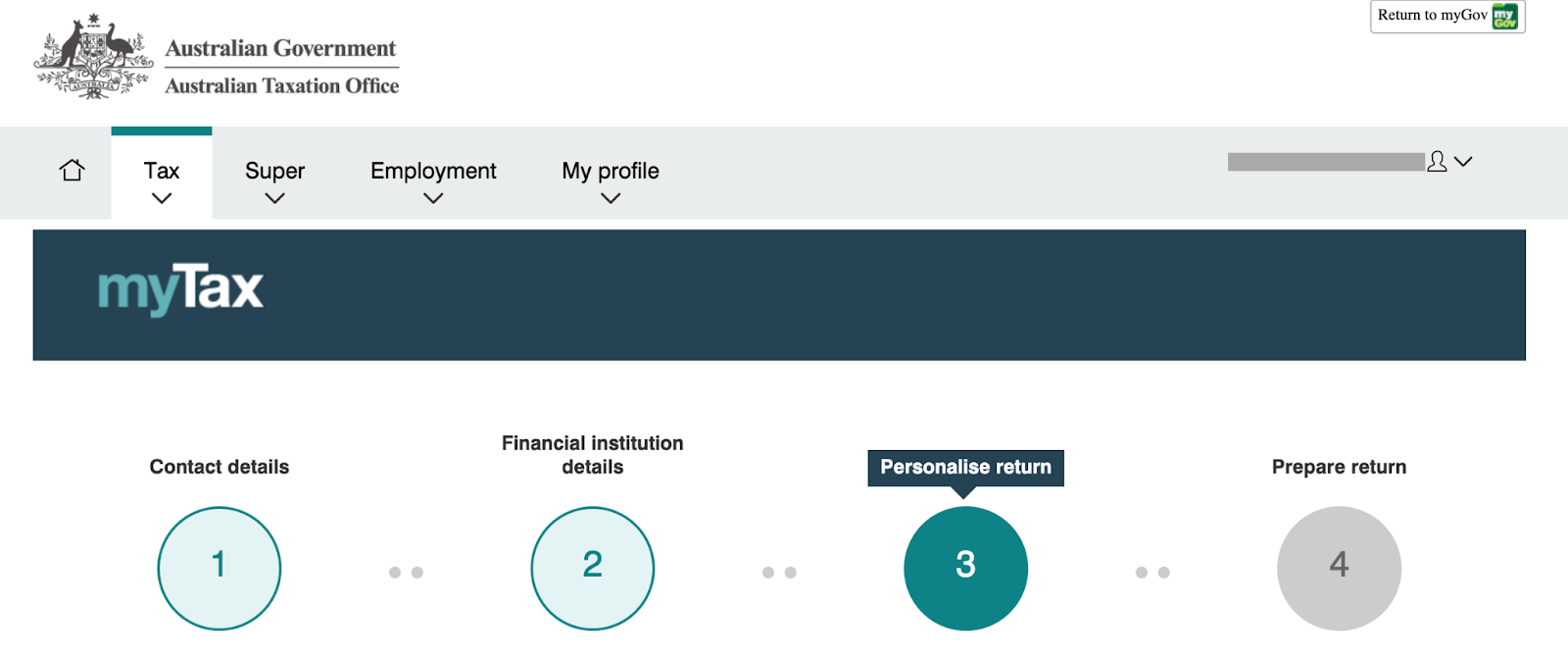
After calculating your gains or losses, you need to report them on your tax return. To report your capital gains and losses on myTax, go to ‘Personalise return’.
mytaxss4

The information provided on this website is general in nature and is not tax, accounting or legal advice. It has been prepared without taking into account your objectives, financial situation or needs. Before acting on this information, you should consider the appropriateness of the information having regard to your own objectives, financial situation and needs and seek professional advice. Summ (formerly Crypto Tax Calculator) disclaims all and any guarantees, undertakings and warranties, expressed or implied, and is not liable for any loss or damage whatsoever (including human or computer error, negligent or otherwise, or incidental or Consequential Loss or damage) arising out of, or in connection with, any use or reliance on the information or advice in this website. The user must accept sole responsibility associated with the use of the material on this site, irrespective of the purpose for which such use or results are applied. The information in this website is no substitute for specialist advice.
FAQ

No items found.
No items found.
Table of contents
heading2
heading3

More resources

CryptoTax Calculator thumbnail
Blog
2
 
Apr
 
2026
The Crypto Neobank You Need Isn't What You Think

Most crypto neobanks are custodied fintech in disguise. Here's what a real Bitcoin onchain neobank looks like, and why the difference matters to your tax position.

Read More
CryptoTax Calculator thumbnail
Blog
12
 
Mar
 
2026
Product Update: Kalshi, MegaETH, CoinRabbit, Bittensor, and WhiteBIT support now live

Summ now supports Kalshi, MegaETH, CoinRabbit, and WhiteBIT. Import your prediction market trades, Layer 2 transactions, lending activity, and exchange data for complete tax reporting.

Read More
CryptoTax Calculator thumbnail
Blog
19
 
Jan
 
2026
Buy, Borrow, Die Strategy Explained: A Tax-Efficient Way to Use Capital

The Buy, Borrow, Die approach has long been used in traditional finance to preserve wealth, optimize taxes, and maintain exposure to appreciating assets. With the rise of crypto-backed lending, the same framework has become increasingly relevant for digital asset holders, making it accessible far beyond institutional circles.

Read More

Try Summ today

Import your transactions and generate a free report preview.

Blog

23 June 2023

X

 Min read

How to Report Crypto Taxes with ATO myTax 2024

A complete step-by-step guide to filing your crypto taxes with the ATO through myTax using Crypto Tax Calculator's ATO myTax report.

Key takeaways

  • Crypto is classified and taxed as property by the ATO. Capital gains tax (CGT) applies when you sell crypto for a profit, and income tax applies to crypto earned via rewards like staking.
  • You need to collect all of your crypto transaction data for the financial year and calculate any income earned and your capital gains/losses.
  • You report your crypto activity in your annual tax return using the ATO’s myTax portal (or through a registered tax agent).

This tax guide is regularly updated: Last Update 

....

August

30

2024

Given the popularity of myTax in Australia as the ATO’s official online platform for tax reporting, it’s important to understand how to report your crypto profits, losses, and income alongside your regular income and capital gains.

To accurately report your crypto transactions on myTax, you will need to calculate and enter both your crypto capital gains and losses, and any crypto income (like staking rewards or airdrops).

Crypto Tax Calculator can help you track your gains and losses, calculate your capital gains, and get ATO-ready reports in minutes.

Get started with a quick overview of how to report your crypto tax in myTax, or keep reading for detailed step-by-step instructions with screenshots from the ATO’s myTax portal.

{{how-to-report-crypto-on-your-taxes-in-9-steps}}
{{save-yourself-hours-of-calculations}}

Step 1: Gather your documents and data

Accurate crypto tax reporting in Australia starts with thorough recordkeeping, as required by the ATO. Before lodging your tax return through myTax, you’ll need to collect a full summary of your crypto transactions for the financial year. This includes any:

The easiest way to do this is to use tax software like Crypto Tax Calculator which will automatically analyse your transaction history once you connect your exchange accounts or wallets.

Alternatively, most exchanges will let you download a CSV or excel file with your transaction history and relevant information, which can be used to manually calculate your taxes. If you're unable to get this information from your exchange or wallet, then you may need to keep your own records.

For each crypto transaction, the ATO expects you to have the following information to report it on your taxes:

  • A description of the crypto asset
  • The date you acquired and sold the asset and supporting receipts
  • The value in AUD at the time of the transaction
  • The cost base (including purchase price, transaction fees, and other relevant costs)
  • The resulting capital gain or loss
  • Records of any accounting or legal fees you’ve paid or tax software you’ve used
  • Digital wallet records and keys

You can wait until you're preparing to file your tax return to gather these documents and transaction data. However, keeping records throughout the year will likely be easier (and more accurate) so they're ready to go when tax season rolls around.

{{get-started-free-with-trustpilot}}

Step 2: Set up myTax to prepare and personalise your return

To lodge your tax return with myTax, you’ll need to set it up first. Start by creating a myGov account – or using your existing one – to connect to the ATO. From your linked services you will then select ‘Manage tax returns’ to report your tax. You will then need to calculate and report CGT, income, and deductions. If you’re in the middle of filling out the forms but need more time to calculate, you can save what you’ve done so far and come back to myTax at any point.

Here’s how you can prepare your crypto taxes in myTax:

  1. Sign into your myGov account and make sure you’ve linked your account to the ATO to access myTax. Then select Tax → Lodgements → Income tax
mytaxss1
  1. Click ‘Prepare’ for your 2024-2025 Individual income tax return.
mytaxss2
  1. Make sure your contact and banking details are up-to-date. Then select ‘Personalise return.’
mytaxss3
  1. Fill out the relevant boxes for your regular income. Note: some of the boxes may already be selected, if the ATO has received information from your employer, bank, crypto exchange, or another organisation. Most of your pre-fill tax information will be available by late July.

Step 3: Calculate your capital gains and losses

Whenever you dispose of crypto at a profit or loss, a capital gains event is triggered. To figure out how much tax you might owe, you need to calculate your capital gains and losses for each transaction. You’ll need to:

  1. Identify each individual capital gains tax (CGT) event. If you’ve conducted hundreds, or thousands of transactions, a crypto tax calculator like Crypto Tax Calculator can help you automatically identify your overall capital gains and losses.
CGTeventsAustralia 658x630

{{difference-between-capital-gains-tax-income-tax-events}}

  1. Figure out the cost base of your crypto. Your cost base is what you paid for the crypto in AUD, plus any additional fees such as gas, transfer, or brokerage fees.

Figuring out the cost base can be more complicated when you have multiple transactions of the same token at different times and prices. When this happens, the order in which you calculate disposals can impact your tax owed. The two common methods for determining order are:

  • FIFO (First In, First Out): You sell your earliest purchase first
  • LIFO (Last In, First Out): You sell your most recent purchase first

{{50-cgt-discount}}
The accounting method you choose can impact both the cost base and if you qualify for the 50% CGT discount – since it only applies to assets held for more than a year. Since FIFO takes into account your earliest purchases first, it could increase the chance of you receiving the 50% CGT discounts if you’ve held those assets long term.

Still confused? Crypto Tax Calculator can automatically figure out your cost basis for you based on ATO rules. You can also choose the accounting method that works best for your situation. If you have a lot of transactions or get stuck figuring out your cost base, Crypto Tax Calculator can help automate the tricky calculations to make this process a lot easier.

{{using-crypto-tax-calculator}}
{{use-crypto-tax-calculator-to-calculate-your-capital-gains}}

Step 4: Report your capital gain/loss on myTax

After calculating your gains or losses, you need to report them on your tax return. To report your capital gains and losses on myTax, go to ‘Personalise return’.

mytaxss4

Discover savings opportunities and lower your tax with Summ

Get started for free

No credit card required

Track all your swaps, trades and DeFi activity with Summ for easy tax reporting

Get started for free

No credit card required

Struggling with your tax?

Let Summ do the hard work for you.

Select country

Connect accounts

Get tax report

Get started for free

No credit card required

Automate your record keeping with Summ

Get started for free

No credit card required

Get started for free

No credit card required

Frequently asked questions

How is crypto tax calculated in Singapore?
I lost money trading cryptocurrency. Do I still pay tax?

The way cryptocurrencies are taxed in most countries mean that investors might still need to pay tax, regardless of whether they made an overall profit or loss. Depending on your circumstances, taxes are usually realized at the time of the transaction, and not on the overall position at the end of the financial year.

How do I calculate tax on crypto-to-crypto transactions?

In most countries you are required to record the value of the cryptocurrency in your local currency at the time of the transaction. This can be extremely time consuming to do by hand, since most exchange records do not have a reference price point, and records between exchanges are not easily compatible.

How can Summ help with crypto taxes?

You just need to import your transaction history and Summ (formerly Crypto Tax Calculator) will help you categorize your transactions and calculate realized profit and income. You can then generate the appropriate reports to send to your accountant and keep detailed records handy for audit purposes.

Can't I just get my accountant to do this for me?

We always recommend you work with your accountant to review your records. If you would like your accountant to help reconcile transactions, you can invite them to the product and collaborate within the Summ web app. We also have a complete accountant suite aimed at accountants.

Does Summ handle non-exchange activity?

Summ (formerly Crypto Tax Calculator) handles all non-exchange activity, such as onchain transactions like Airdrops, Staking, Mining, ICOs, and other DeFi activity. No matter what activity you have done in crypto, we have you covered with our easy to use categorization feature, similar to Expensify.

Do I have to pay for historical tax reports?

Our subscription pricing is per year not tax year, so with an annual subscription you can calculate your crypto taxes as far back as 2013. The process is the same, just upload your transaction history from these years and we can handle the rest.

Can I use my own accountant?

Yes, Summ is designed to generate accountant-friendly tax reports. You simply import all your transaction history and export your report. This means you can get your books up to date yourself, allowing you to save significant time, and reduce the bill charged by your accountant. You can discuss tax scenarios with your accountant, and have them review the report.

How does payment work?

Summ has an annual subscription which covers all previous tax years. If you need to amend your tax return for previous years you will be covered under the one payment.

What if my exchange is not on the list of supported exchanges?

Summ covers thousands of exchanges, wallets, and blockchains, and DeFi apps, but if you do not see your exchange on the supported list we are more than happy to work with you to get it supported. Just reach out to [email protected] or via the in-app chat support feature and we will get you sorted.

Does Summ support NFT transactions?

We do! Summ integrates with many NFT marketplaces and offers categorization options for any NFT-related activity (minting, buying, selling, trading).

How does the free trial work?

Summ is free to use immediately upon signup, allowing you to import your transactions and take advantage of our smart suggestion and auto-categorization engine, portfolio tracking, DeFi and NFT support. For access to reports, the tax loss harvest tool or chat and priority support, you will need to upgrade to the appropriate paid plan.

Automate your crypto bookkeeping

01

SOC 2 type 2 certified

As SOC 2 Type 2 compliant, we ensure robust data security, giving customers confidence in entrusting us.
02

Secure organization

We conduct regular and thorough Security & Awareness training for all employees.
03

Full data privacy

Our application only ever requires 'read-only' access to your data.