How is Bridging Crypto Taxed?
Wondering about the tax implications of bridging your crypto assets? We’ve got the answers for you in our blog.
Belangrijkste punten
- If bridging is considered a disposal by tax authorities, then it is a taxable event.
- Software like Summ (formerly Crypto Tax Calculator) can help you record and calculate the taxes you owe from bridging crypto.

What is bridging?
Just as the name suggests, a blockchain bridge connects two different chains and allows assets to move from one to the other. Bridging is a relatively new transaction type that has been born out of necessity as more blockchains are created and DeFi users wish to move their assets from chain to chain to take advantage of different opportunities.
Bridging often consists of many different transactions and can even result in the change of the underlying asset to a pegged or wrapped derivative (depending on the bridge and source/destination chain). Summ can handle these complex transactions, allowing you to reconcile any cross-chain transactions and report your tax obligations correctly.
What are the tax implications of bridging?
Right now, there is a lack of specific guidance on the tax implications of bridging crypto assets from the majority of tax regulatory bodies around the world. This has led to two dominant schools of thought on the issue: those who see bridging as a taxable event (conservative), and those who do not (aggressive). Let’s dive in.
In most regions, a capital gains taxable event regarding crypto activity happens when there’s a ‘disposal’ of an owner’s asset. A disposal is defined as a change of ownership in a specific asset; for example, when selling ETH for BTC. The seller is ‘disposing’ of their ETH to receive BTC in return.
The conservative approach:
For those who classify bridging as a taxable event, they view the bridging event itself as a disposal. When transferring a crypto asset cross-chain, they believe that this asset has left the beneficial ownership of it’s original holder when making this journey. The discussion hinges on the argument that moving assets across fundamentally different blockchains might be considered creating materially different assets, accompanied by the argument that by granting the smart contract the ability to make this cross-chain journey, the owner is giving up ownership over their assets.
The aggressive approach:
In the aggressive approach, it is argued that because of the lack of guidelines available from your tax regulatory body, bridging is the equivalent of transferring crypto between two wallets owned by the same user. You would argue that, as a result, this doesn’t constitute a disposal event, and as such, you wouldn’t incur capital gains tax.
We recommend that you work with a local tax professional to decide what approach is best for your personal circumstances.
Summ. Built for DeFi.
How can Summ help?
Handling Bridging in the Platform
To handle bridging using Summ, follow these simple steps:
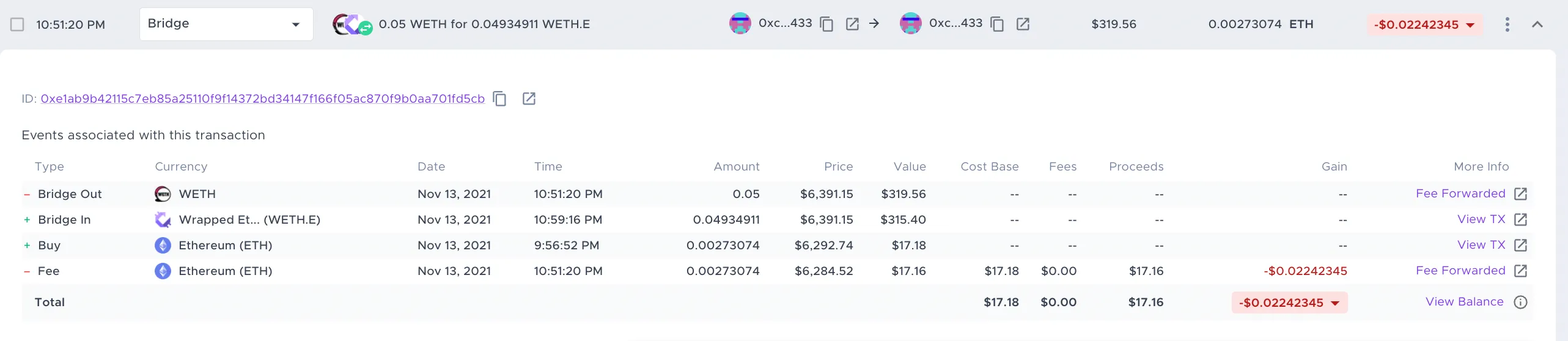
- Find the transactions related to the bridging event under ‘Review Transactions’. Usually they will be split into an ‘outgoing’ component (sending to the bridge) and an ‘incoming’ component (receiving the asset on the other chain). The example below shows 0.5 WETH being bridged from Ethereum to Avalanche.

- Re-categorize the ‘outgoing’ component as ‘Bridge Out’. Do this by clicking on the category box, selecting ‘Advanced’ and then choose the category ‘Bridge Out’ on the right side of the page.

- Re-categorize the ‘incoming’ component as ‘Bridge In’ using the same process as step 2.
- The two components will then group to form a single line categorized as a ‘Bridge’. The cost basis from the original asset will be moved across to the asset on the destination chain, even if it is a pegged or wrapped version of the original asset.
Important Notes
- Both the ‘Bridge Out’ and ‘Bridge In’ components must occur within a 24 hour timeframe for them to be grouped together.
- A ‘Bridge Out’ will match with the next ‘Bridge In’ in chronological order if the following criteria are fulfilled:The two components are within 24 hours
- The amount that is received is similar to the amount that was sent (5% tolerance accepted)
If multiple bridges of the same amount are done in the same 24 hours, ensure that the corresponding ‘Bridge Out’ and ‘Bridge In’ are chronologically one after the other.Bridging transactions will not be auto-categorized, they require manual selection due to the complex nature of the transaction.The cost basis of the original asset on the source chain will be transferred to the asset that is received on the destination chain whether it is the same asset or a pegged/wrapped version.
De informatie op deze website is algemeen van aard en vormt geen fiscaal, boekhoudkundig of juridisch advies. Ze is opgesteld zonder rekening te houden met jouw doelstellingen, financiële situatie of behoeften. Voordat je op basis van deze informatie handelt, moet je nagaan of de informatie passend is voor jouw eigen doelstellingen, financiële situatie en behoeften, en professioneel advies inwinnen. Summ (voorheen Crypto Tax Calculator) wijst alle garanties, toezeggingen en waarborgen, expliciet of impliciet, van de hand en is niet aansprakelijk voor enig verlies of schade (waaronder menselijke of computerfouten, nalatig of anderszins, of incidentele of gevolgschade) die voortvloeit uit, of verband houdt met, het gebruik van of vertrouwen op de informatie of adviezen op deze website. De gebruiker aanvaardt de volledige verantwoordelijkheid voor het gebruik van het materiaal op deze site, ongeacht het doel waarvoor dit gebruik of de resultaten worden toegepast. De informatie op deze website is geen vervanging voor deskundig advies.

Nick is a licensed attorney and the Head of Tax at Summ (formerly Crypto Tax Calculator), with over 6 years of experience in the crypto tax space. He has previously held key roles at Deloitte and TurboTax, focusing on digital asset taxation and blockchain compliance. At Summ, Nick helps drive the development of a leading software that enables taxpayers around the world to accurately and efficiently complete their crypto taxes.
Meer bronnen

Lost, Stolen or Hacked Crypto - Tax Implications
Are you someone who has unfortunately had crypto stolen or hacked, or maybe you just lost access to it? Learn the tax implications in our blog article.
Lees meer
Is swapping crypto taxable? IRS rules for 2025
Swapping one crypto for another is a taxable event, and you will need to work out the USD value of your capital gain or loss to report on your taxes.
Lees meer
How To Report Crypto On Form 8949
In this guide we’ll run through everything you need to know about Form 8949 and how to fill it out.
Lees meer
DeFi Taxes in the US: Your Complete Guide for 2025
The complete guide to understanding and filing your DeFi taxes in the US.
Lees meer